


Test: SRAM Force 1: Is it worth switching to Sram's simple, derailleur-less X-Sync chainring? Our long-term test shows: If you do without a chain ring and front derailleur, you win when cross riding instead of having to do without.
“Less is (sometimes) more” – that sounds unrivaled trite and can be thrown out at pretty much every opportunity. When SRAM presented its first CX1 group about three years ago (at that time still with mechanical rim and disc brakes), we weren't the only ones to ask ourselves why fewer gears should be "more". After all, component manufacturers had been adding one sprocket after another for decades; with 22 gears, we thought we were finally well equipped in terms of transmission – with a large range and fine gradations. So why throw half of that overboard with the SRAM Force 1, especially since the Americans' yaw front derailleurs offered an almost perfect change between the chainrings?
SRAM Force 1: different shifting behavior off-road
The answer lies in the shifting behavior, which looks significantly different in cyclocross than in road cycling. On the road you can hardly do without the fine one-tooth gradations of a cassette like 11-27, because under heavy loads, whether uphill or on the flat, it is important to always keep the cadence and torque in the optimal range. Even a two-man jump can lead to the feeling that you are stepping into space in the easier gear, while the effort quickly becomes too great in the heavier one. So you switch back and forth helplessly and only have the choice of driving into the red area or staying below your potential.

On the cross-country bike, however, things are different. Winding courses, changing ground conditions and short, toxic gradients lead to constant changes in speed. You almost come to a standstill in front of the slippery hairpin, behind it you have to accelerate to racing speed again; sometimes you need a lifebelt on a steep slope, sometimes you need a thick gear to overtake on a broader section of the route. Basically, shifting is permanent, and if you rely on a classic racing bike cassette - let's say 11-12-13-14-15-16-17-19-21-24-27 - you will find that the gears are mostly in the Double pack changes, because the narrow gradations do not match the strong changes in speed when cross-country skiing. It is often enough to change gear three or four times in a row, for example when you have to get off your bike at full speed to jump over an obstacle. When accelerating, you then have to – click, click, click – shift through the high gears tooth by tooth again. And switching between chainrings complicates things even further. On the one hand you have to take a lot of power off when shifting at the front, on the other hand changing the blade requires time-consuming compensatory shifting processes on the rear wheel, even if the blades are only ten teeth different, which is typical for Cross bikes.
SRAM Force 1: the right gear is faster
All of this speaks in favor of confidently choosing a somewhat coarser gradation, which has a difference of two teeth in the middle and three to four teeth towards the top. The resulting scope is used for a larger overall scope, as offered by a cassette with 11-32 teeth. Combined with a 42 chainring, the result is a development that corresponds almost exactly to the 46/36 gradation with a 12-27 ring.

Of course, this is not just theory, but our personal experience with the different switching systems. Already on the first tour with the SRAM Force 1 over our standard training round, we noticed: Despite the coarser gradation, an "intermediate gear" is never missing. When driving into a steep section, the correct gear is available more quickly, because instead of five shifting steps from the 16 to the 25 sprocket, only three are now necessary (from the 18 to the 28). It's a similar story when shifting up - maybe you have to step up a little bit harder, but we have the feeling that we're picking up speed faster.
Up to this point, "fewer" gears can be equated with an equally large overall range without noticeable losses - so where is the "more"? On the one hand, it is due to the already described reduction in gear changes and the complete elimination of chainring changes - both have a positive effect on dynamics and off-road riding fun. Then there is the shifting behavior as such, and at this point we want to delve a little deeper into the technology of the SRAM Force 1.
SRAM Force 1: the chain holds thanks to the X-Sync chainring
Two decisive changes help the SRAM Force 1 to achieve precise and safe shifting with just one chainring. The first (and most important) point is the X-Sync chain ring, developed by the SRAM engineers in Schweinfurt and now copied by many other manufacturers. It is equipped with two different types of teeth - one sharp and angular like the blade of a flathead screwdriver, the other shaped like an elongated hexagon. The narrow teeth fit between the inner plates of the chain, the hexagonal ones between the outer plates. In addition, all teeth are so long that they protrude from the top of the chain.

As a result, SRAM ensures that the chain rests extremely securely on the ring, without the chain guard rings that are common with conventional 1x drivetrains. It is almost impossible for the chain to fall off in the event of a fall or when shifting gears. The X-Sync chain ring has another special feature: in relation to the crank spider, the teeth are offset a few millimeters inwards, so they are exactly between the large and small ring of a double crank. This ensures that the chain line is correct even when the bike is skew.
New feature number two is the special rear derailleur of the 1x system. Compared to a normal SRAM rear derailleur, it looks huge with its medium-length cage and large jockey wheels; at 260 grams, it is also around 100 grams heavier. The strong spring that pulls the shift rocker backwards is striking. It ensures that the chain tension is always high enough, whether the 11 or the 32 sprocket is on. (In)audible effect: With this rear derailleur, the link strand does not hit the chainstay.

SRAM Force 1: Cage Lock locks the rear derailleur

The Cage Lock device is very practical: If you turn the shifting rocker forward and press the button with the lock symbol, the rocking arm locks and the chain sags without tension. So you can quickly and cleanly remove or install the rear wheel; this also makes it easier to cut the chain to length.
The safe fit of the chain does not affect the shifting behavior. Gear changes are smooth and precise in both directions; even when the largest sprocket is in contact, no additional friction is felt. While older SRAM cassettes were generally a bit more "lazy in shifting" than their Shimano counterparts, the PG-1170 and the cheaper PG-1130 are up to date. Despite its large overall range, the 11-32 package is quite finely graduated: four one-steps, two two-steps, three three-tooth steps and a final four-step ensure that all gear steps are between 10,7 and 11,6% - overall the cassette is therefore graded very evenly.
SRAM Force 1: even gradation in many variants
 And with that you are well prepared in the field, as Velomotion was able to determine in training and at the first race of the season. Whether it's a short steep section or a fast flat section - the Elffach-Kranz always has the right gear ready. Compared to the racing bike, the larger rolling circumference of the cross tires also ensures that the highest gear on the test bike, at 38-11, seems long enough.
For real racers there are of course also larger chainrings - in steps of two up to 48 for a 110 bolt circle (and for criterium racers and time trial bikes 52 and 54). The shift lever of the SRAM Force 1 can be operated crisply without the necessary manual strength being excessive; the strong springs of the rear derailleur are not noticeable when changing gears.
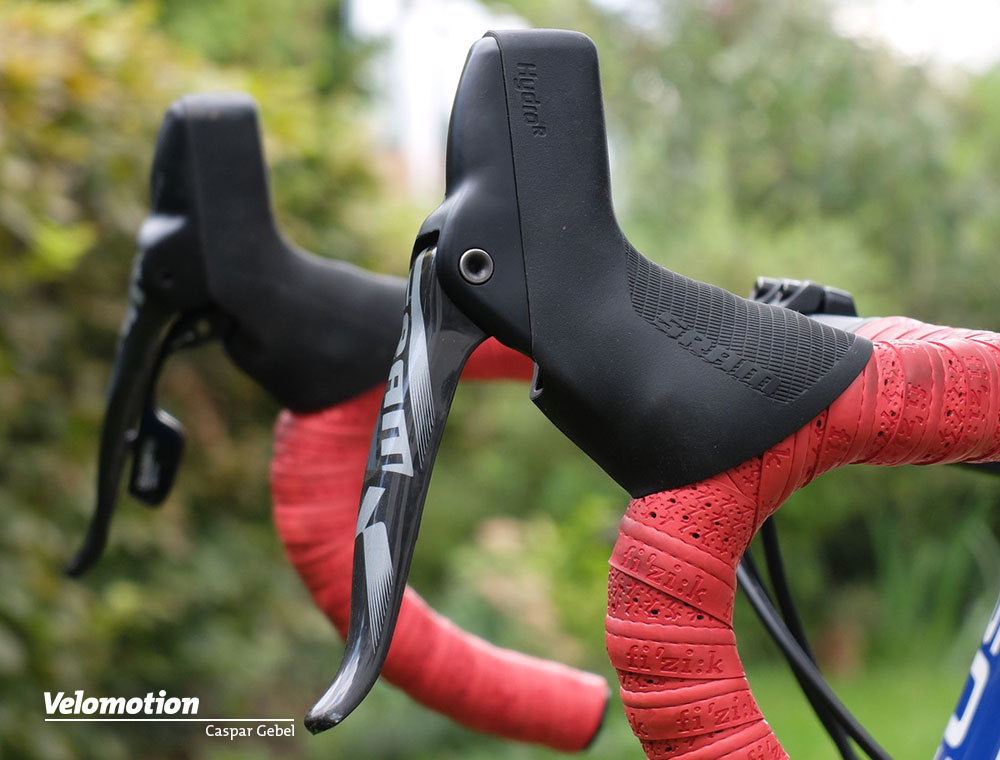
Of course, the feel of the left lever is unusual, as it has a deep hole on the underside – where the mechanism of the derailleur lever used to be. You don't miss the thrower itself, it's more noticeable in the race that you can find the right gearing much faster if you don't have to shift gears at the front as well.
SRAM Force 1: the hydraulic disc brakes are also convincing

The SRAM Force 1 includes hydraulic disc brakes, which Velomotion was able to test right away and which are convincing in all areas. In an emergency, the brake allows sharp deceleration and can be finely modulated. The rotors have slightly rounded edges, so the alleged risk of injury is excluded; The compact brake calipers are visually very pleasing and also light. The only thing that stands out about the grippy levers is the fairly large free travel, but you don't pull the brake lever too close to the handlebars.
Velomotion mounted the group on a slightly older Focus Crosser, which has modern equipment with internal cable routing and RAT thru axles. Adjusting the gears is easy if you follow the instructions - the correct distance between the sprockets and the upper pulley is important. With a little skill, you can also lay the hydraulic lines yourself.
SRAM Force 1: 600 grams weight saving
Incidentally, compared to the 2×10 groupset with a light aluminum crankset and the mechanical-hydraulic brakes of the Focus, the Force group saved a whopping 600 grams - the rather burly Focus Crosser comes with an aluminum frame and inexpensive DT Swiss wheels so including pedals to exactly nine kilos. In this respect, too, converting to 1×11 is worth considering, although of course it depends on what components are replaced. In addition, the bike looks much tidier without the front derailleur, its gear cable and a possible chain catcher. It is easier to clean, the risk of defects is reduced - overall, the reduction in gears only has advantages on the crosser.
SRAM Force 1: complete group is almost 1.000 euros
The complete SRAM Force 1.000 currently costs around 1 euros - no wonder that complete bikes with the group are hardly available for less than 3.500 euros. However, an existing bike can of course be retrofitted with the 1x components. An X-Sync chain ring is traded at around 65 euros; the Rival rear derailleur, which is practically identical to the Force in terms of weight and function, is available from 85 euros. Entry into the 1x world costs just 150 euros. SRAM also makes the switch to 1-speed palatable because the rear derailleur and chain ring are fully 2-speed compatible. We converted an older Crosser from 10×1 to 10×XNUMX, which worked perfectly – the shifting behavior is not quite as perfect, of course, as the older SRAM levers are not tuned to the strong springs of the Cross derailleurs.
SRAM Force 1 on the scales
| Component | Weight |
|---|---|
| Lever/brake caliper/line on the right | 433g |
| Lever/brake caliper/line on the left | 344g |
| rear derailleur (medium length) | 263g |
| Crankset 175mm / 38 ring | 609g |
| Cassette 11-32 | 308g |
| chain (unabridged) | 280g |
| Centerline brake disc (pair) | 236g |




Lex says
Very good article. I liked it. Thanks for that.
Wolfram Eckhoff says
Against nothing? I have a different opinion!
1. The grips are extremely uncomfortable, and the square shape of the master cylinder makes your hands hurt.
2. The gear cable runs heavily out of the gear lever when shifting up, especially in the first 3 or so gears it can practically only be pulled out with force - the rear derailleur doesn't manage it or only does so with a delay. It is not due to the cable routed to the derailleur, checked only with the shift cable in a short sleeve. Obviously the train has to "slip" over the plastic handle while turning and grinds a braking groove into it.