


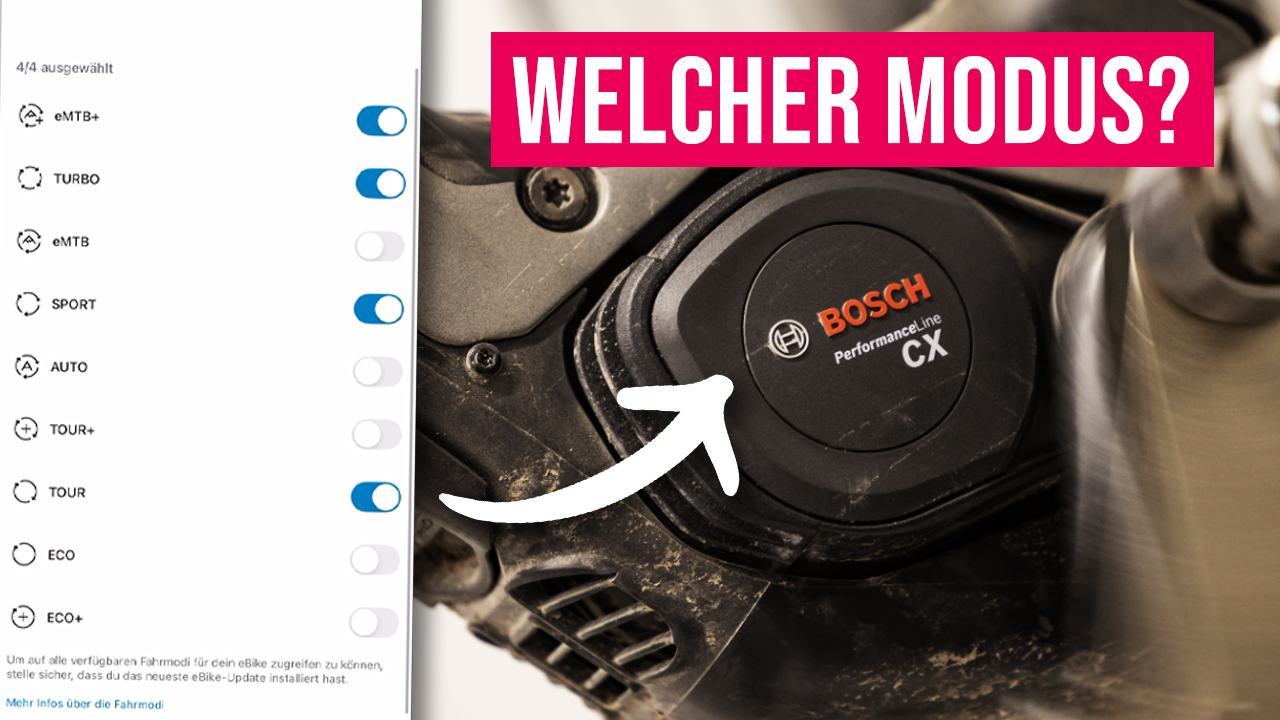
Test: The Bosch Smart System offers e-bikers a wealth of support levels, but many only utilize a fraction of their potential. With around a dozen different riding modes, it's easy to lose track. Factory settings often remain untouched, missing valuable opportunities to adapt to your own riding style and preferred terrain. We examined the modes in detail, analyzed them on the test bench, and identified their characteristics to answer the question: What are the differences, which level is suitable for which purpose, and how do you get the most out of your Bosch e-bike?
The Bosch Smart System is likely the most widely used drive system on e-bikes, at least in this country – from everyday city bikes to powerful e-mountain bikes. A key component of its success is its high level of adaptability, which is particularly evident in the variety of available support modes. But this variety can also be overwhelming. Those who don't actively engage with the settings in the associated Flow app can sometimes miss out on considerable potential. It's worthwhile to understand the differences between the modes to optimize the riding experience – whether for a leisurely tour, sporty trail riding, or daily commuting.
The basics of Bosch e-bike modes: What you need to know
Before we delve into the technical details of the individual stages, it is important to clarify some basic framework conditions of the system.
Four modes at the moment: Selection via the Flow app
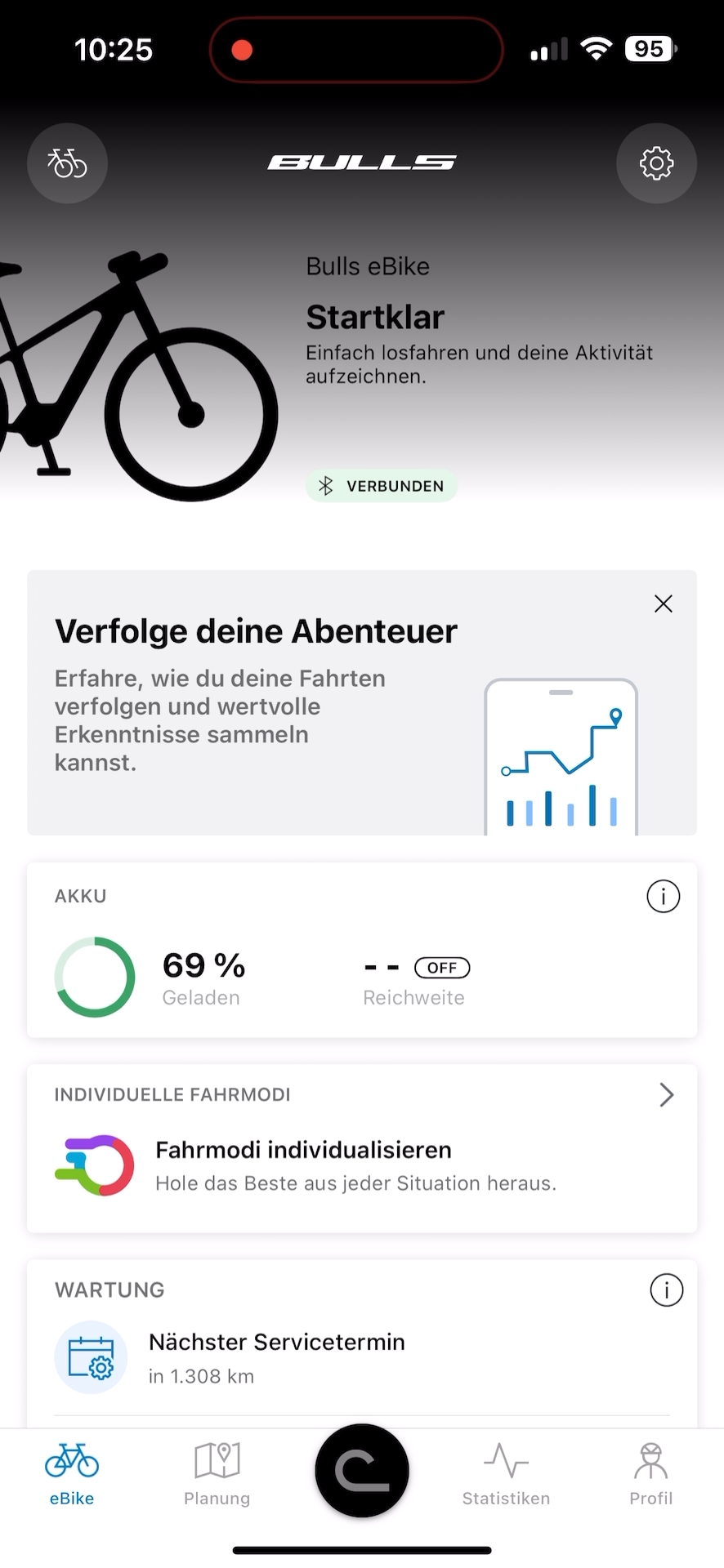
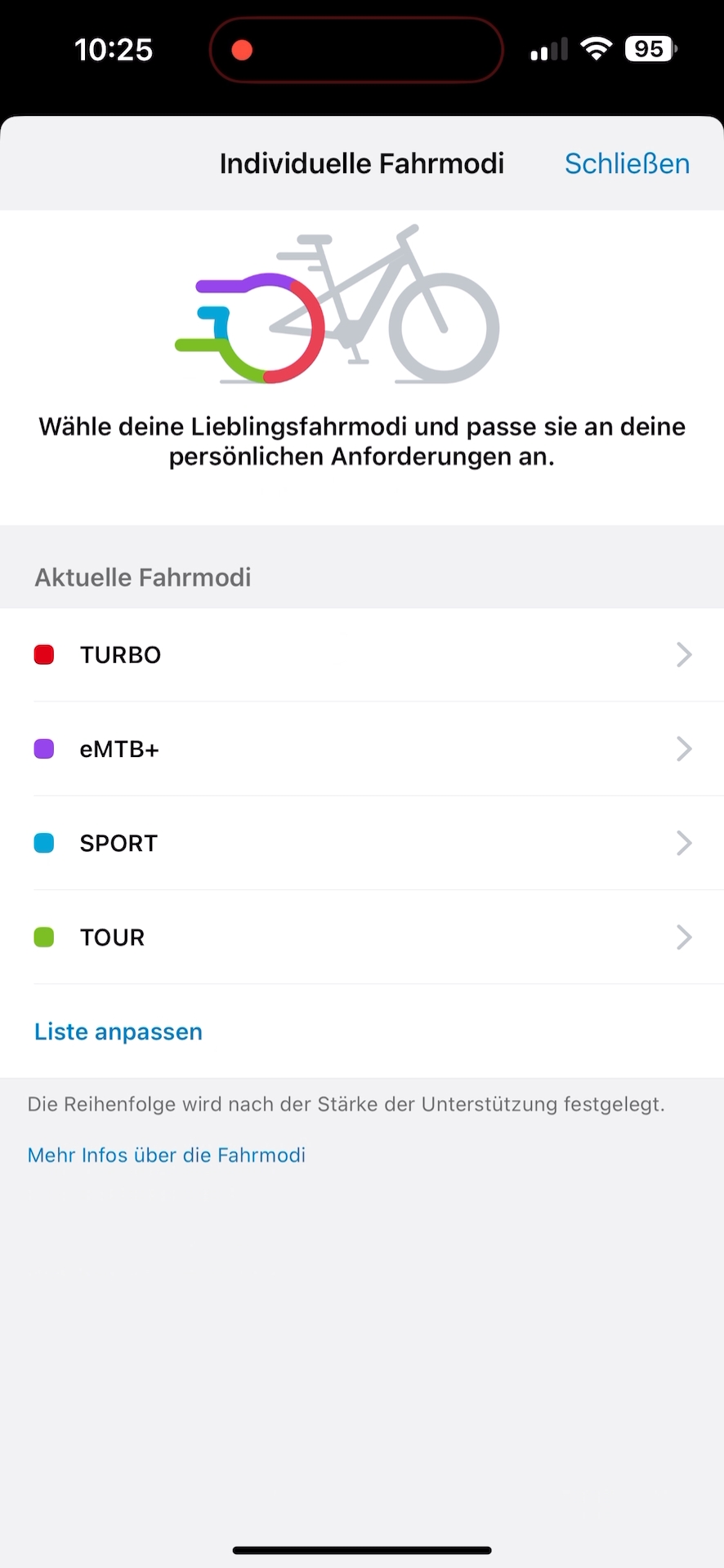
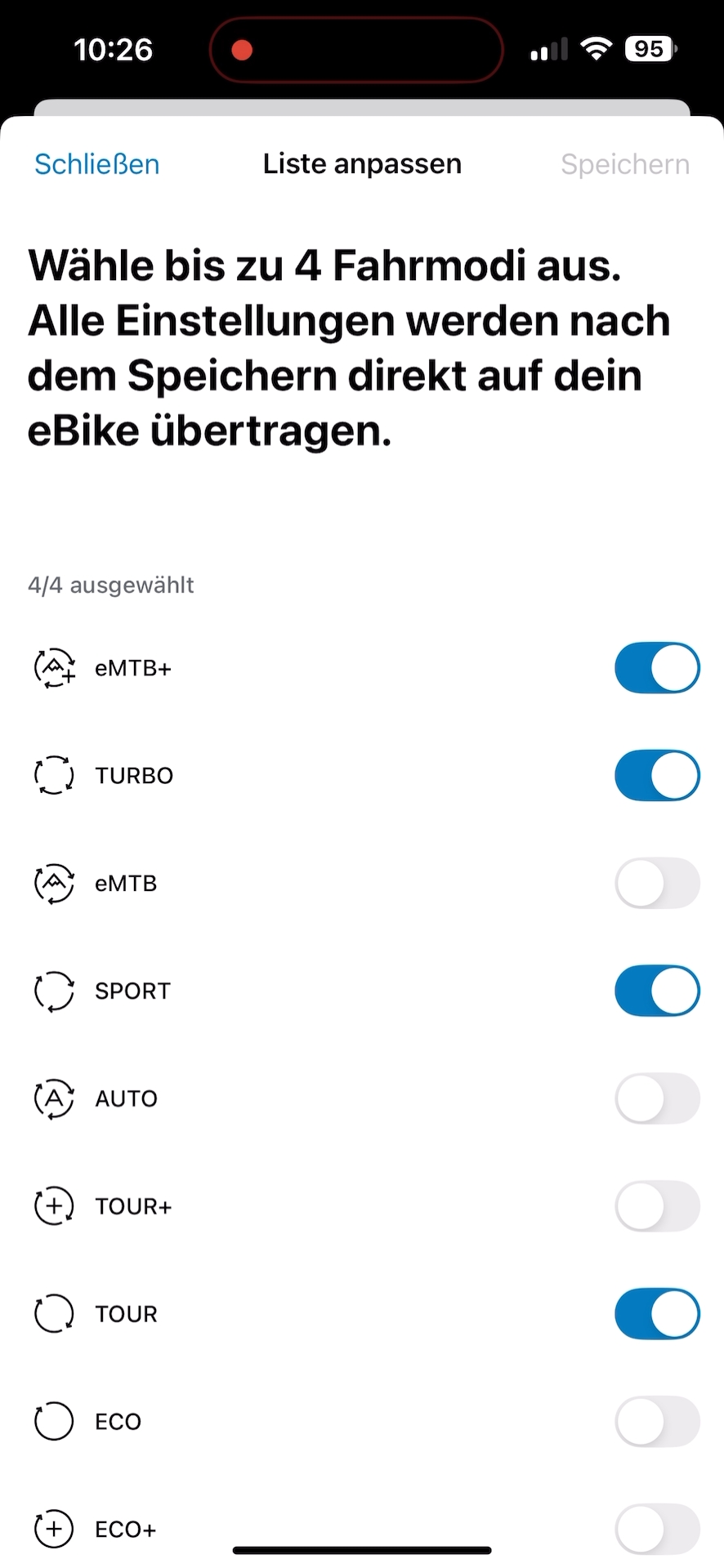
A key point is that the Bosch system only ever actively offers four support levels on the bike at a time. These can be cycled through using the control unit on the handlebars. However, to choose from the entire portfolio of available modes or to adjust the order, a connection to the Bosch eBike Flow app on your smartphone is essential. The menu item for customizing the modes can be found in the e-bike's settings. Somewhat hidden at the bottom of the page is the option "Customize list". Here, users can select up to four favorites from a list of all the riding modes enabled for their system and transfer them to the bike. The process of changing modes itself only takes a few moments and can easily be done before a ride.
Not every mode for every bike
The availability of the dozen or so modes depends on several factors. Not every motor can control every mode. The most prominent example is the "Race" mode, which is reserved exclusively for the Performance Line CX Race motor. Likewise, an "eMTB" mode designed for sporty use cannot be loaded onto an Active Line motor designed for urban use.
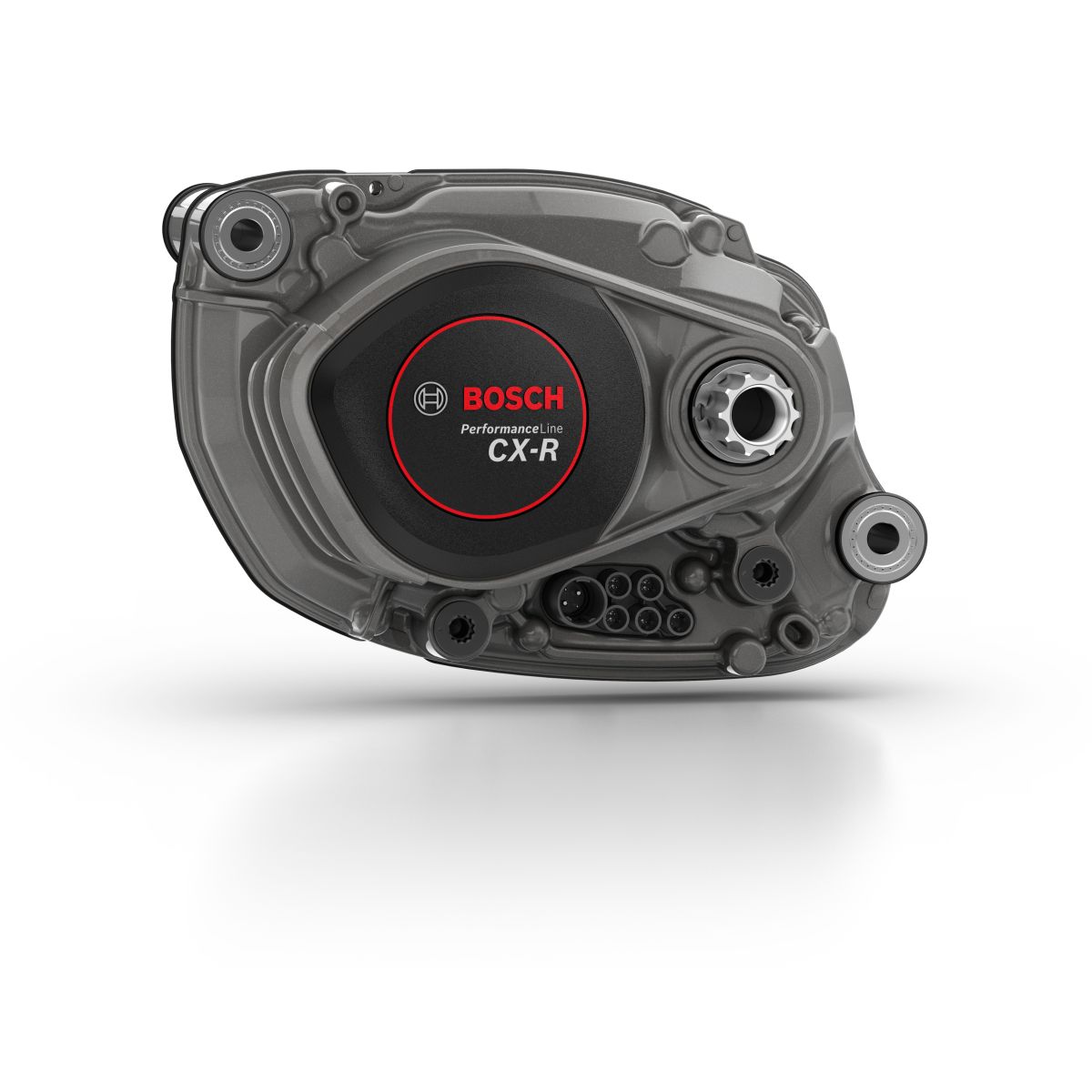
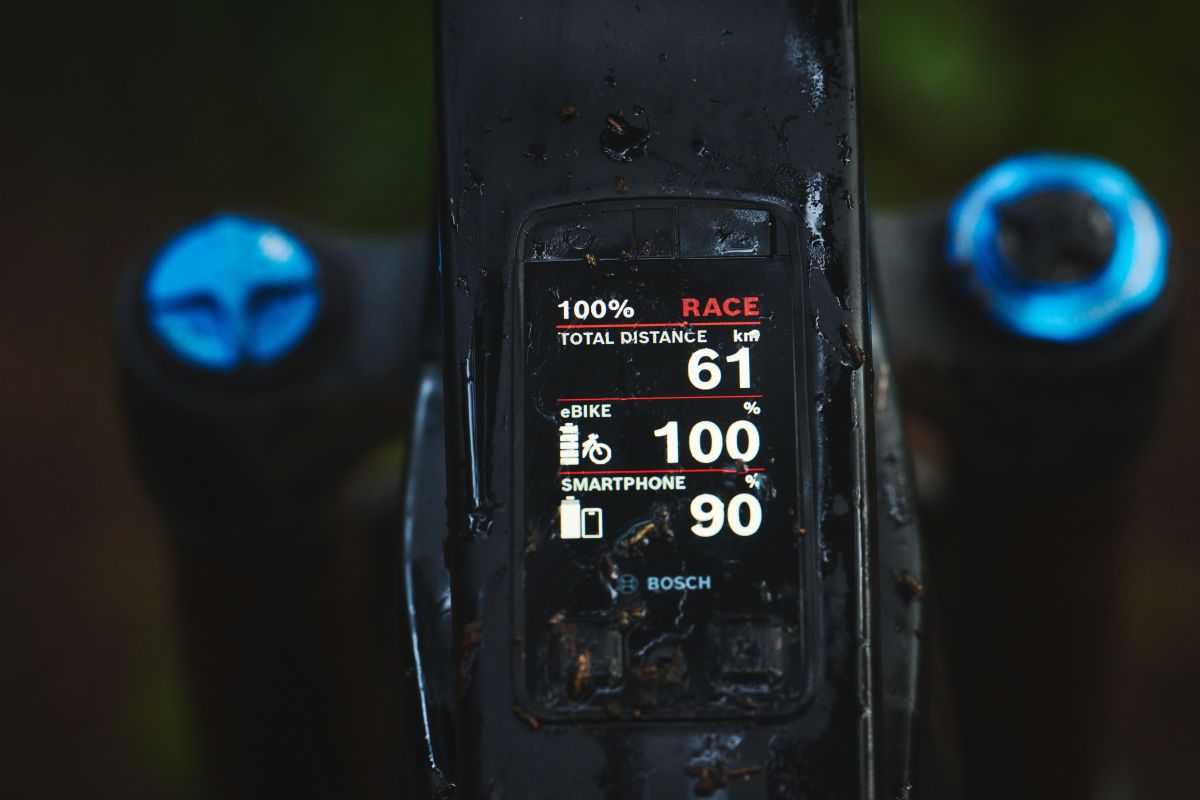
However, the bicycle manufacturer has the final say on the available options. They define which modes are available to the end customer when configuring the e-bike. This selection is generally based on the bike's intended use. Therefore, if a mode discussed in this article isn't available on your bike, the manufacturer is responsible for making the choice. However, experience has shown that the likelihood of adding a missing mode later via a software update is slim.
Three philosophies: Linear, Progressive and Adaptive
To organize the variety of modes, they can be divided into three basic categories that differ in the way they deliver their power: linear, progressive, and adaptive modes.
Linear driving modes: predictable and constant
The linear modes are the originators of Bosch's assistance systems and are very familiar to most riders: Eco, Tour, Sport , and Turbo . Their key feature is a fixed assistance factor. This factor determines what percentage of the rider's power output the motor contributes. For example, if the rider pedals with 100 watts and the assistance factor is set to 100%, the motor also adds 100 watts, resulting in a total output of 200 watts at the drive unit. This factor remains constant across the rider's entire power range.
The result is a very predictable and smooth riding experience. You know exactly what to expect from the engine at all times. This makes the linear modes particularly attractive for touring riders, as they offer no surprises and also make energy consumption easier to calculate.
Progressive (Dynamic) driving modes: Intuitive and sporty
The second group consists of the progressive modes, which Bosch themselves describe as "dynamic." These include the classic eMTB mode as well as the more modern Tour+ and eMTB+ variants . Unlike the linear modes, the level of assistance here varies depending on how hard the rider pedals. With light pedal pressure, the assistance is low, resulting in a very natural starting feel. If the rider increases their effort—for example, on an incline or during a sprint—the level of assistance increases dynamically, and the motor delivers significantly more power.
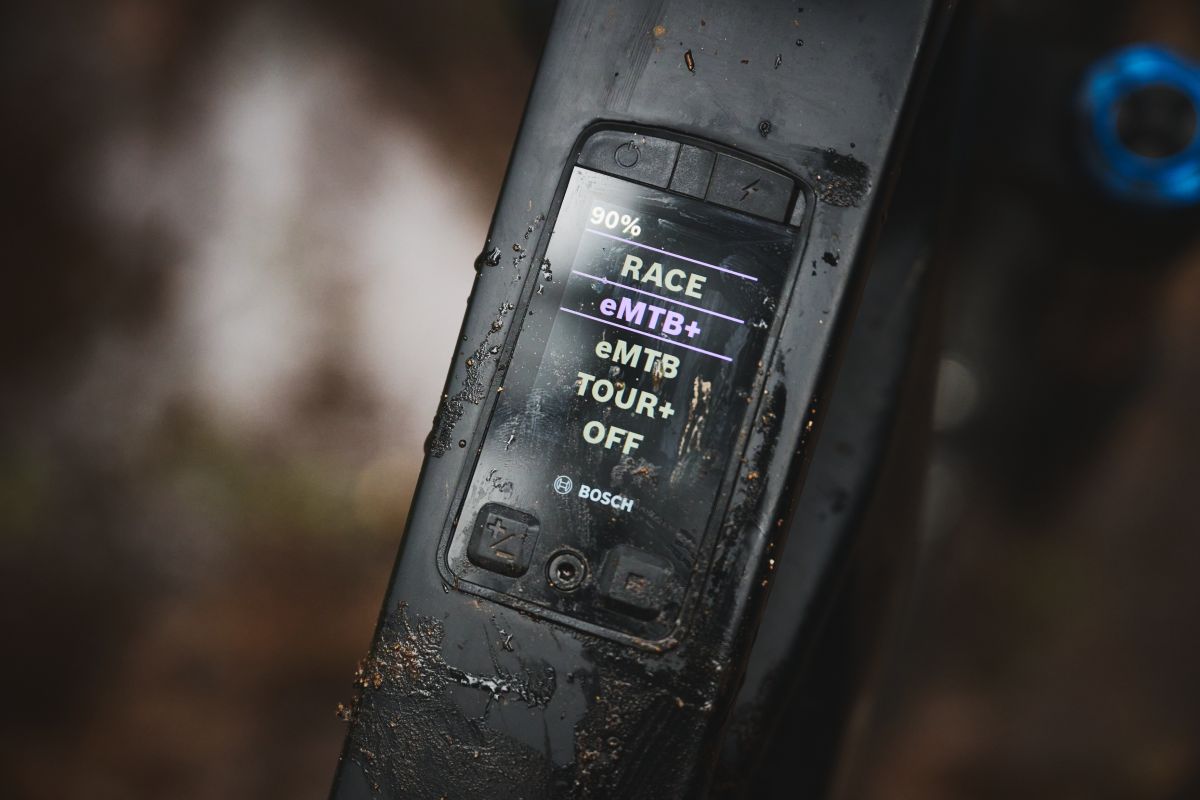
This behavior offers several advantages: It creates a more dynamic, natural riding experience, more closely aligned with conventional cycling. Especially in sporty use, such as e-mountain biking, this significantly improves controllability on technical or slippery sections. Another advantage is the reduced need to constantly switch between assistance levels. The mode adapts virtually automatically to the riding situation and covers a wide range from gentle assistance to powerful thrust.
Adaptive driving modes: The intelligent helpers
The third category comprises the adaptive modes, which include Auto, Cargo , and Eco+ . These modes go a step further, incorporating additional sensor data such as gradient, speed, and cadence into their calculations to optimally adjust the assistance to the specific riding situation. Auto mode, for example, regulates the assistance fully automatically, allowing the rider to concentrate entirely on the traffic or scenery and maintain the chosen cadence. Cargo mode is specifically optimized for e-cargo bikes and delivers powerful yet smooth assistance for effortlessly moving heavy loads. Due to their complexity and dependence on real-world environmental factors, these modes were not included in our laboratory test on the test bench, as realistic riding situations cannot be simulated there.
On the test bench: The Bosch e-bike modes in direct performance comparison
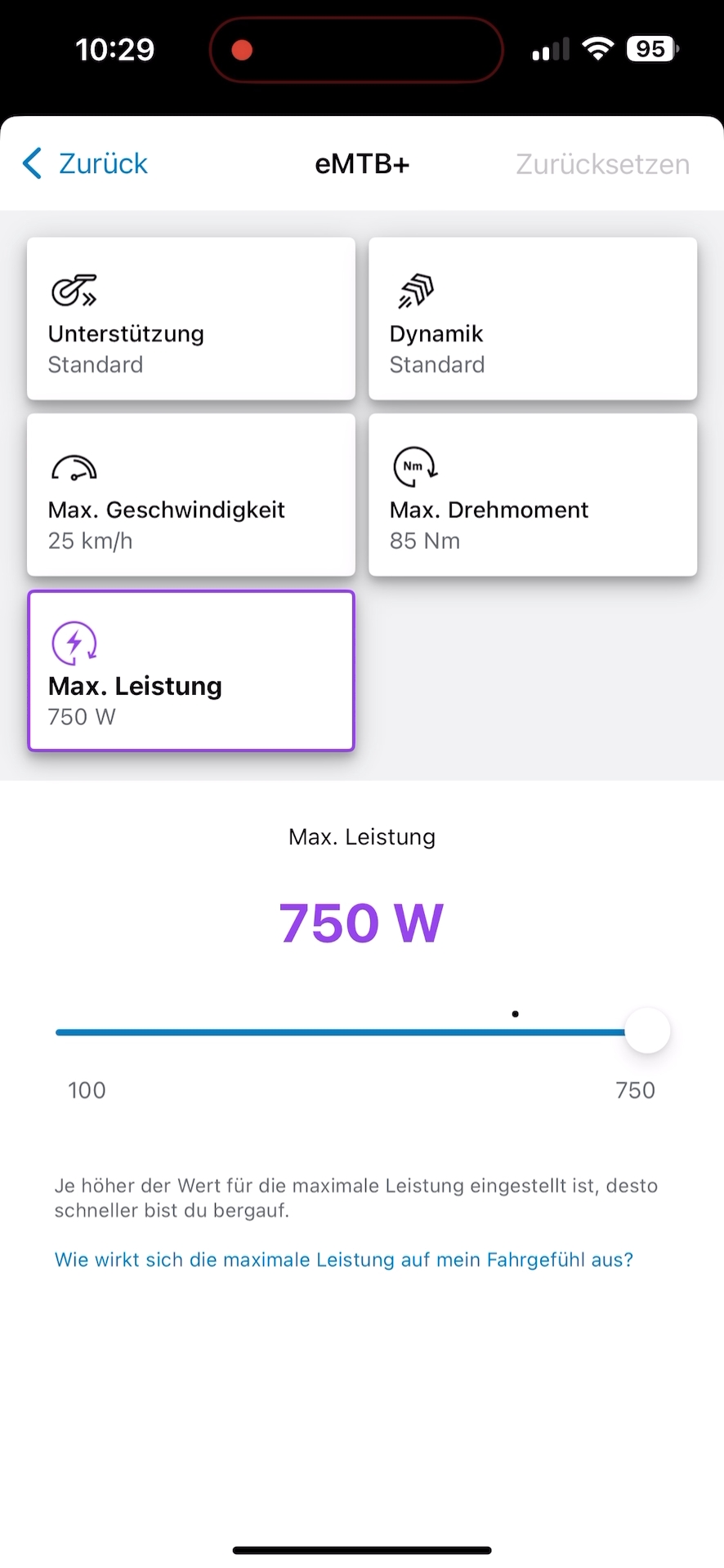
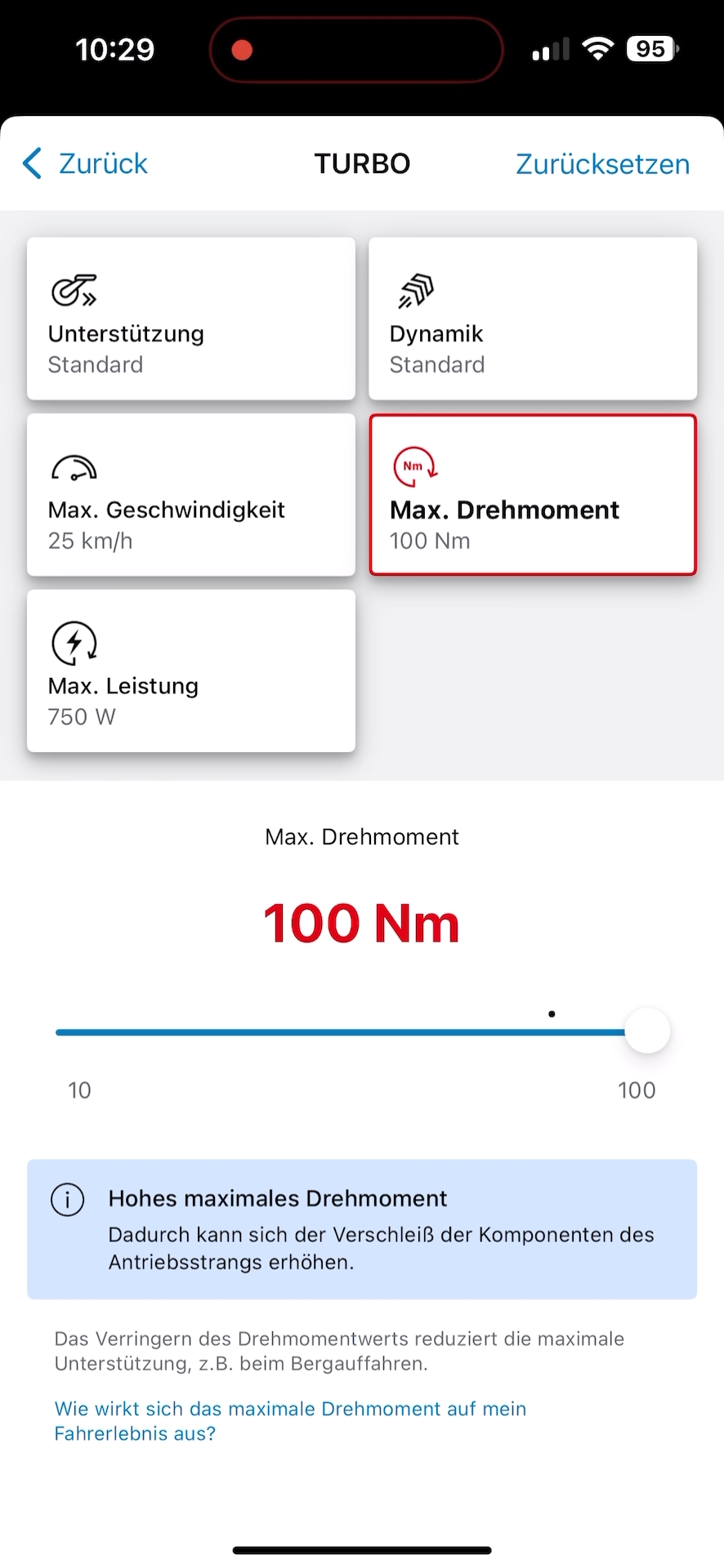
To translate the theoretical differences into measurable data, we analyzed the linear and progressive modes in detail on a power dynamometer. A current Bosch Performance Line CX motor (Gen 5) served as the test system. All modes were reset to factory settings, with one exception: Turbo and eMTB+ modes were set to their maximum power of 750 watts and 100 Newton meters of torque using the available performance upgrade, as we assume most riders use this option.
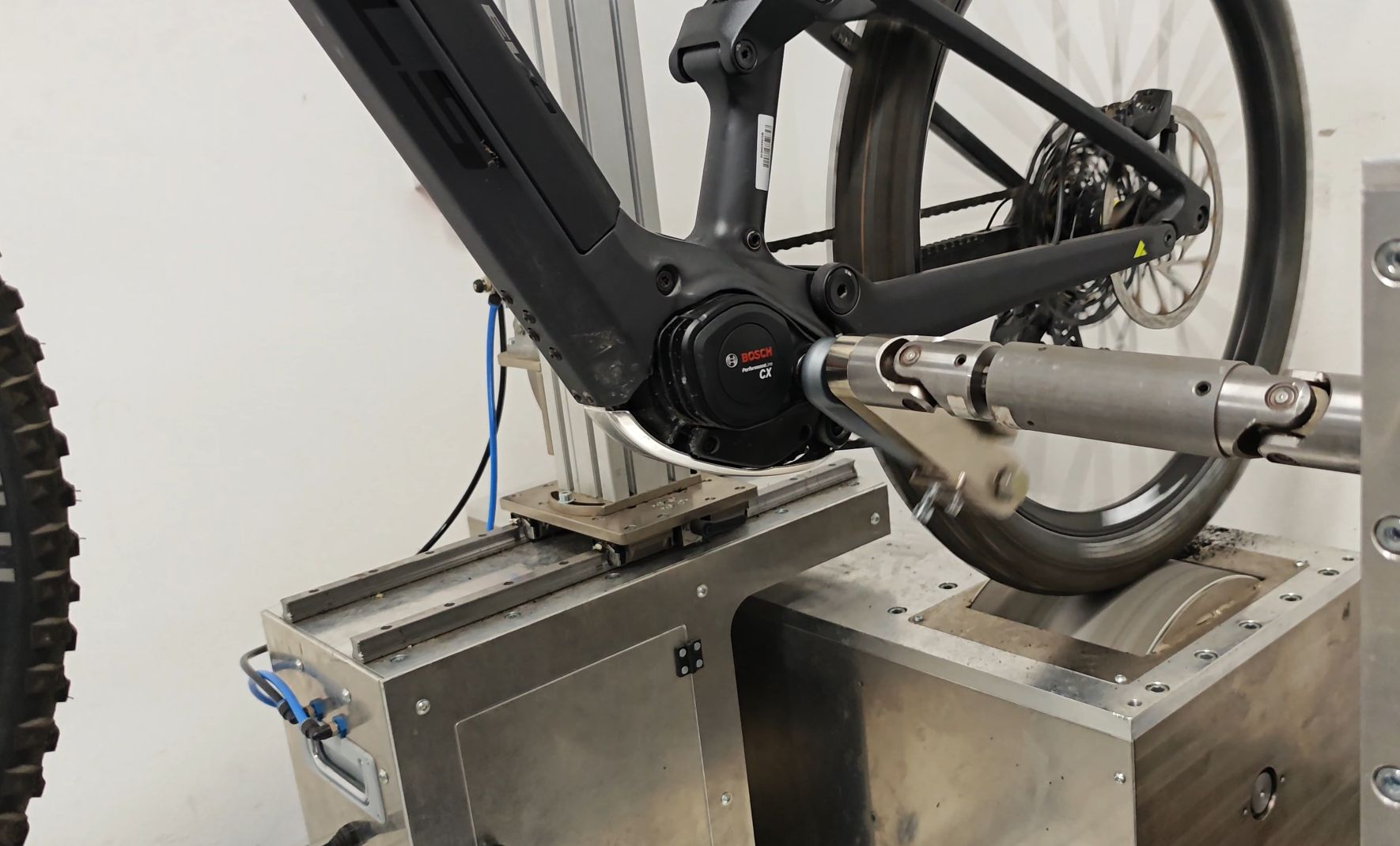
The performance curves in detail
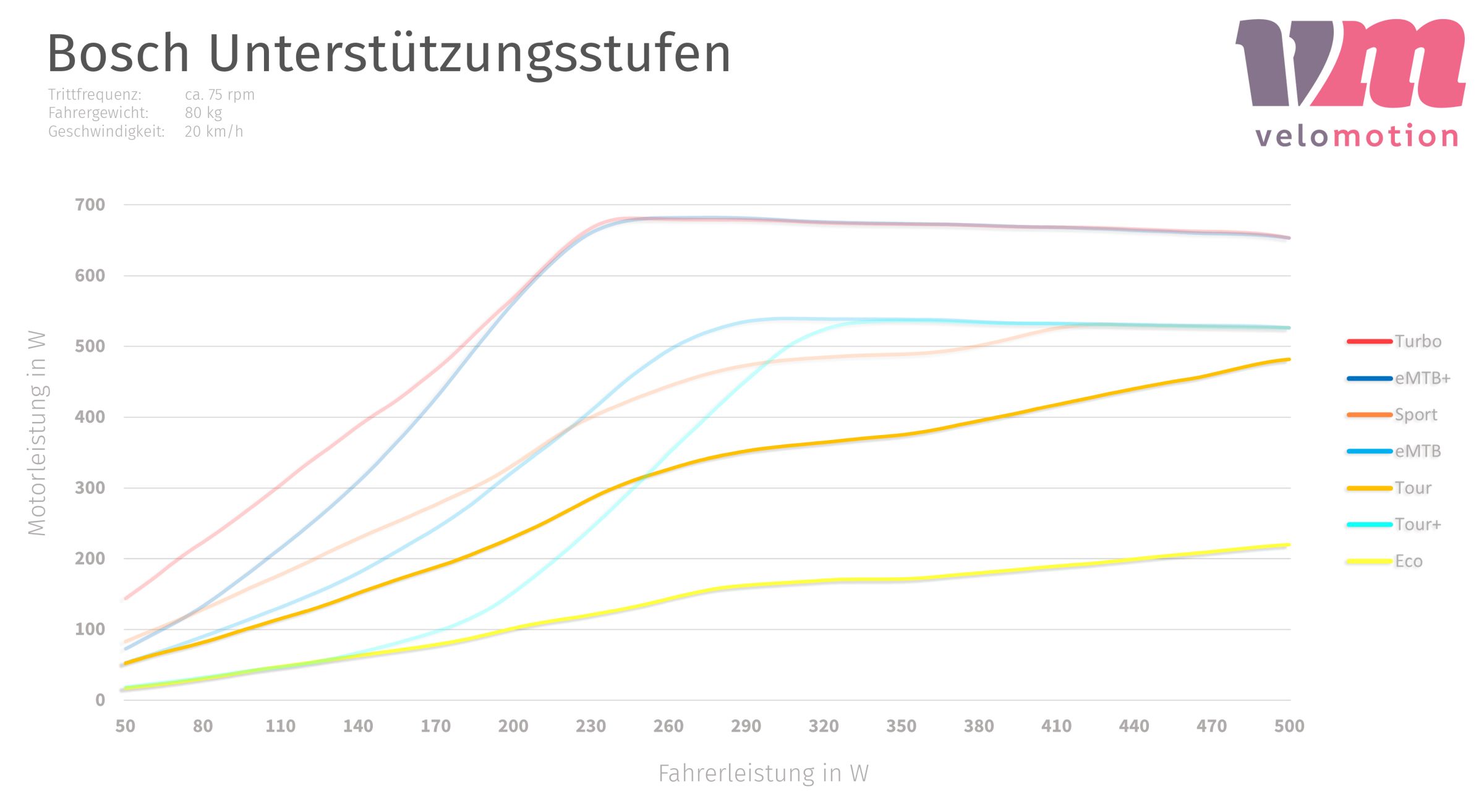
The resulting power curves show how much engine power (Y-axis) is delivered for a given rider power (X-axis). Here, the two main groups of modes can be clearly distinguished from each other. The linear modes (Eco, Tour, Sport, Turbo) exhibit a straight, steadily rising curve. The progressive modes (Tour+, eMTB, eMTB+), on the other hand, exhibit a "bulging" curve: They start flatter and then rise exponentially with increasing rider power.
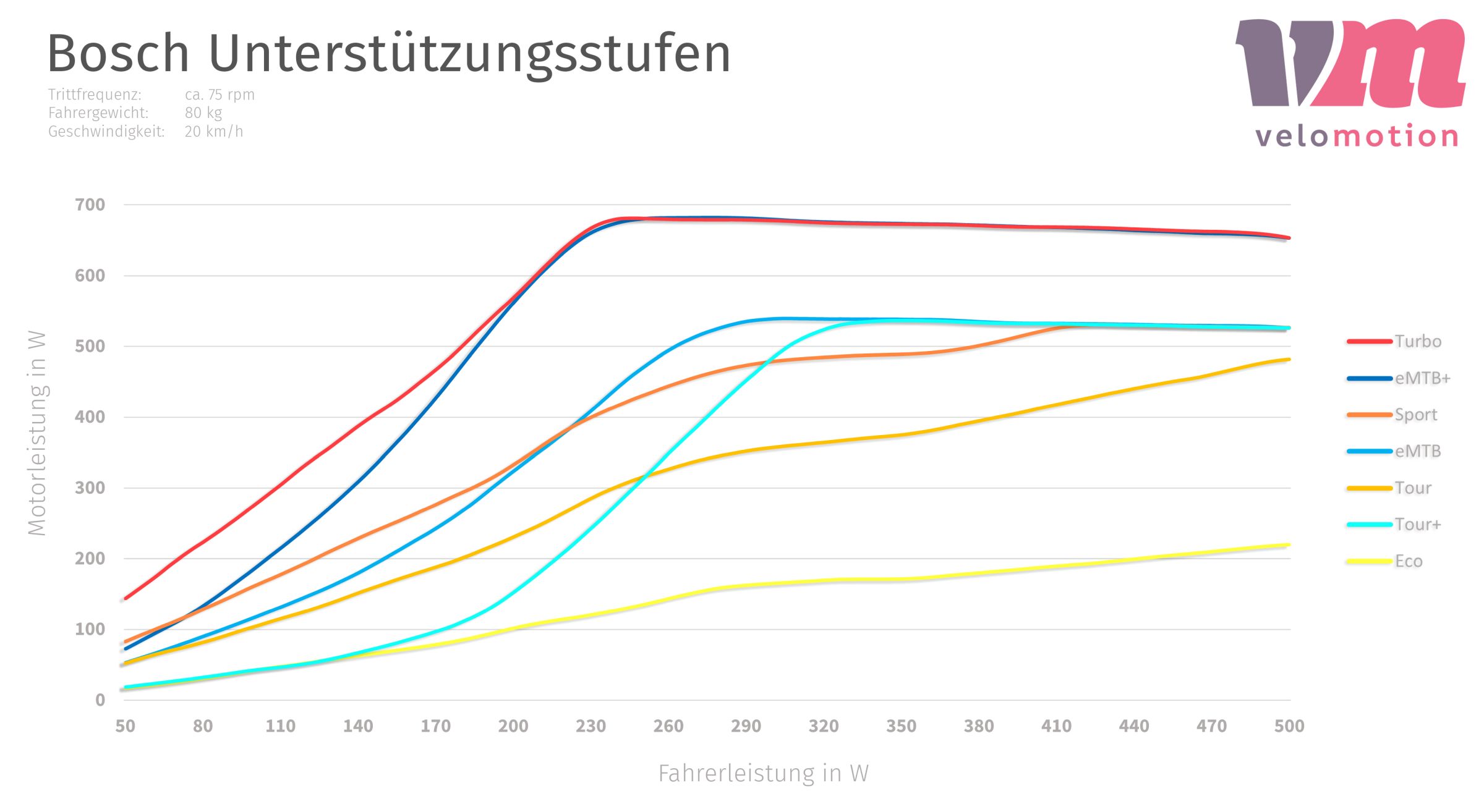
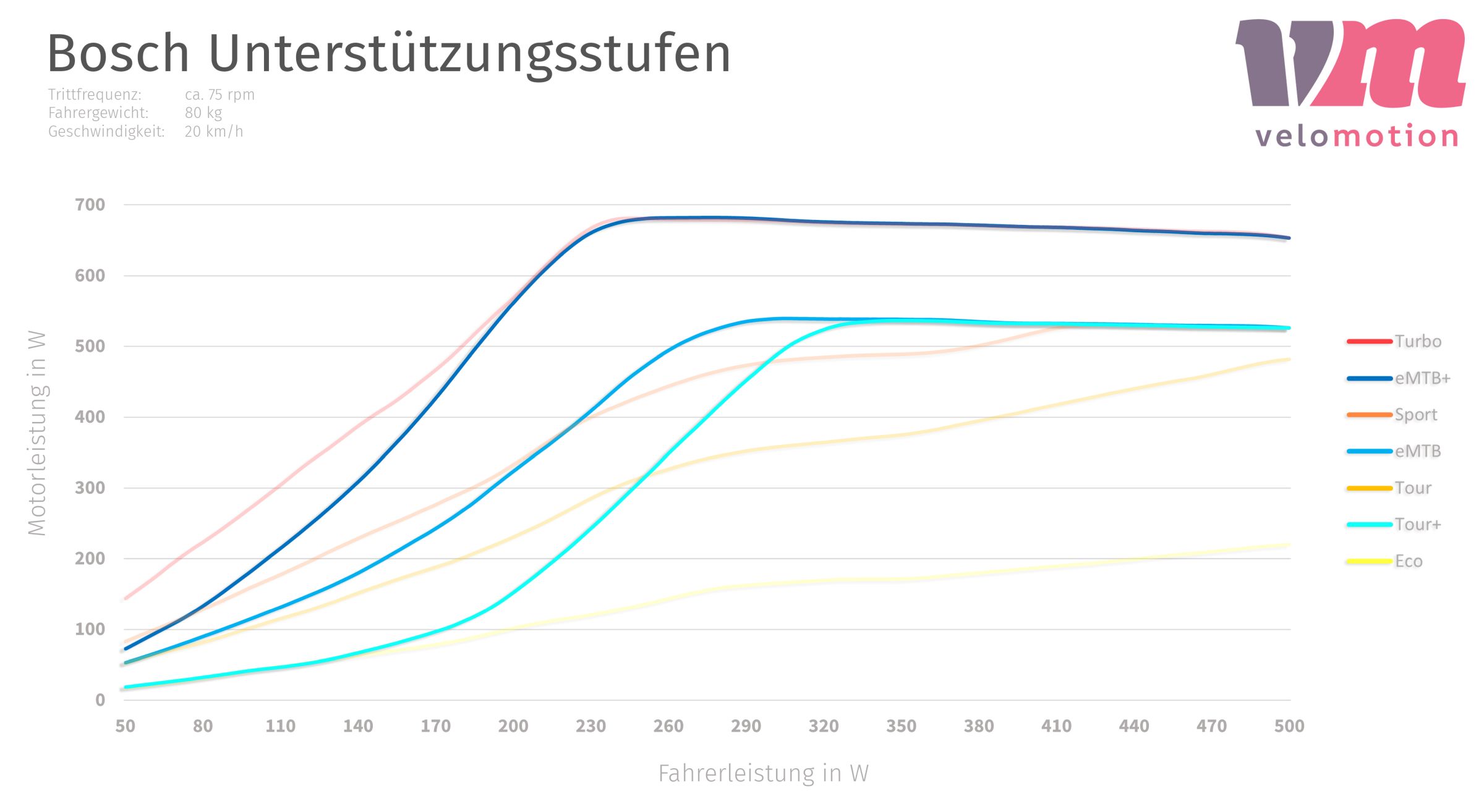
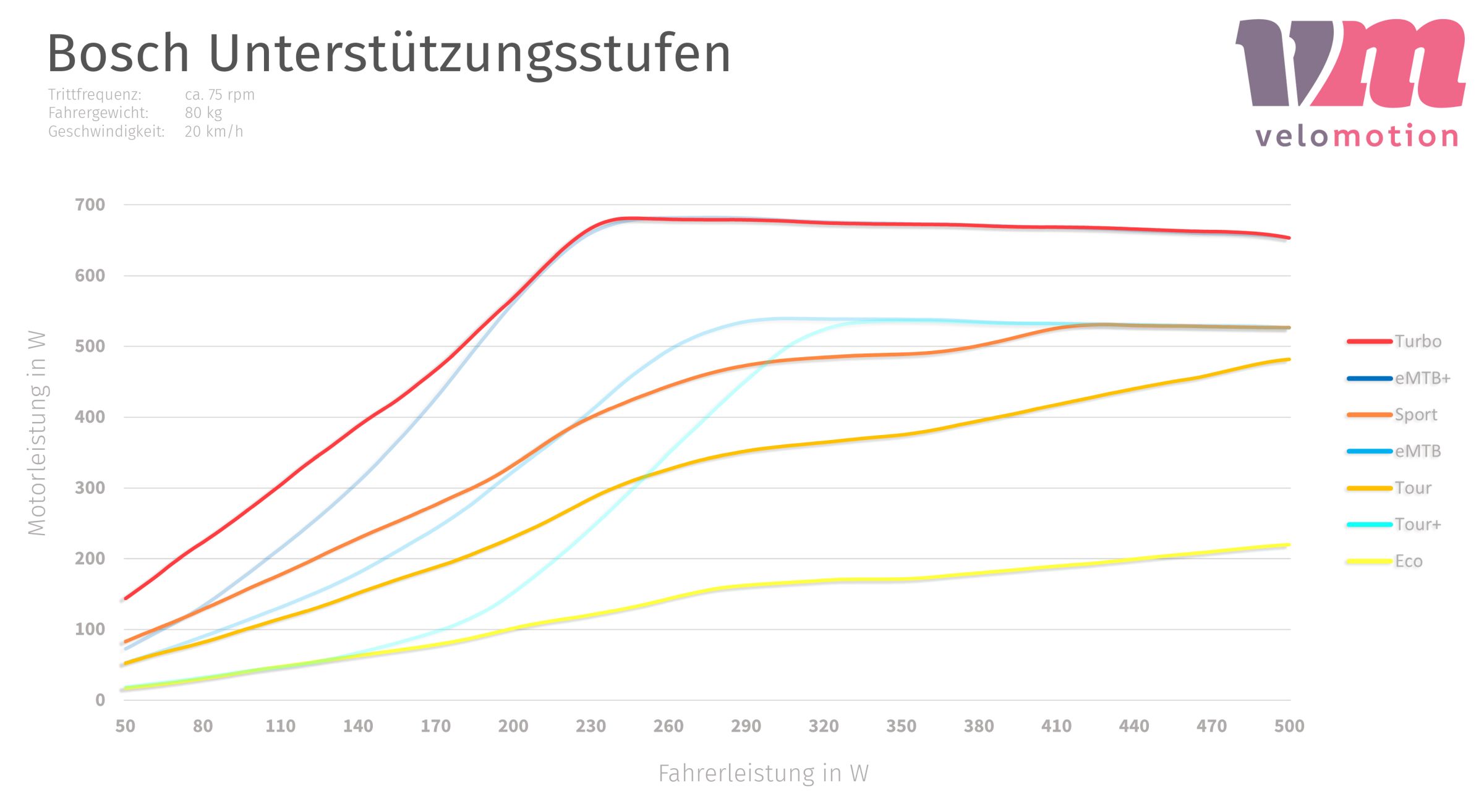
- Turbo & eMTB+: At the top of the performance graph are the Turbo and eMTB+ modes. Their curves are almost identical in the upper power range, starting at around 200 watts of rider power. The eMTB+ mode is essentially the progressive version of the Turbo mode. At lower rider power levels, it delivers noticeably less thrust, which improves controllability. However, as soon as power is demanded, it pulls powerfully and achieves the same peak power. A peculiarity of the CX motor is that the absolute maximum power of almost 700 watts is only reached at a relatively high rider power of around 230 watts. The system is therefore designed to reward sporty riders.
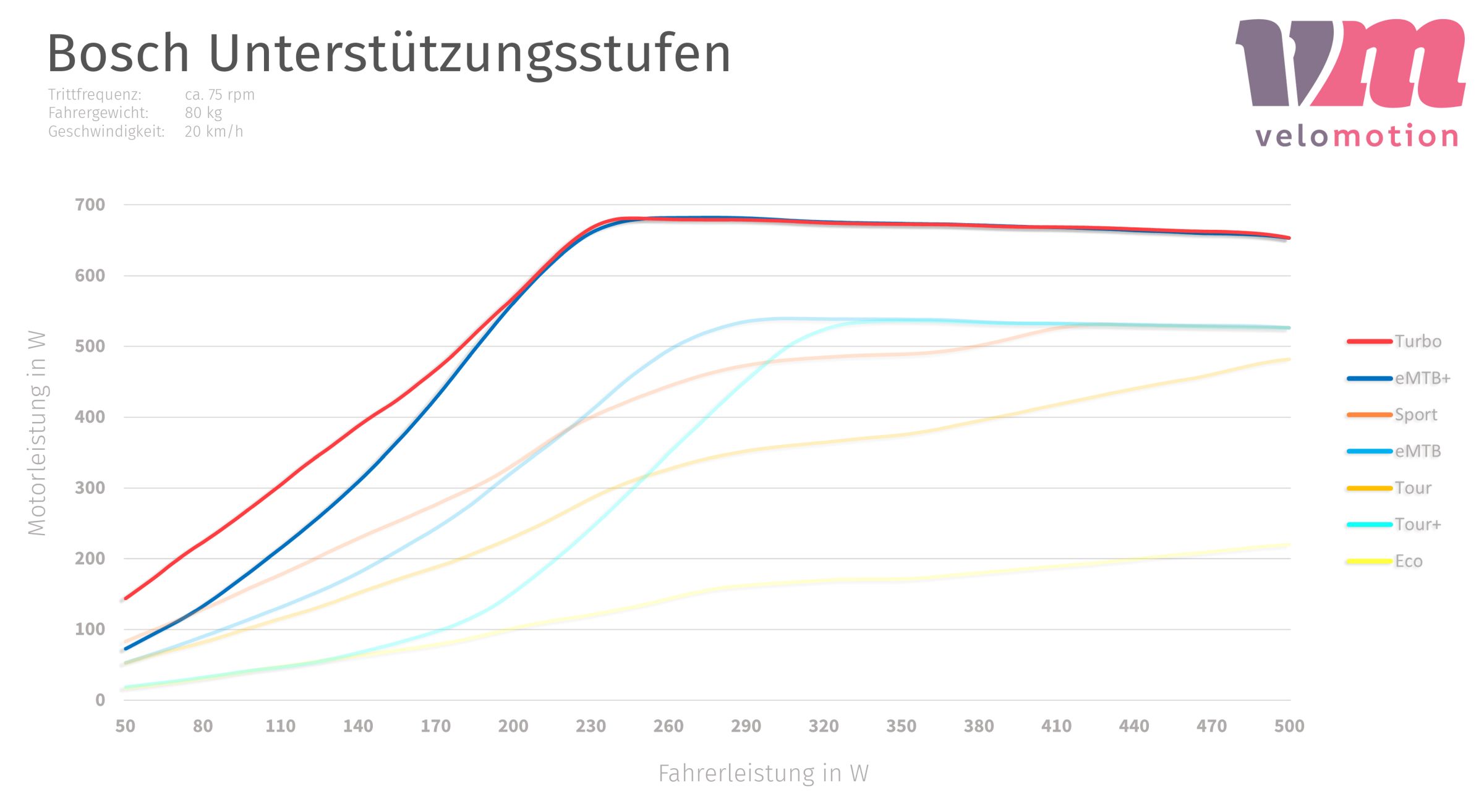
- Sports & eMTB: A similar pair forms one level below. Sport mode acts as a classic, linear mode, while eMTB mode is its progressive counterpart. Interestingly, their curves intersect. At lower rider effort, Sport mode is more powerful, resulting in more direct response. However, at higher rider effort, eMTB mode overtakes it, as its assistance increases progressively, while Sport mode's linear curve is flatter. The choice between these two modes depends heavily on personal riding style and preference for a consistent or dynamic ride feel.
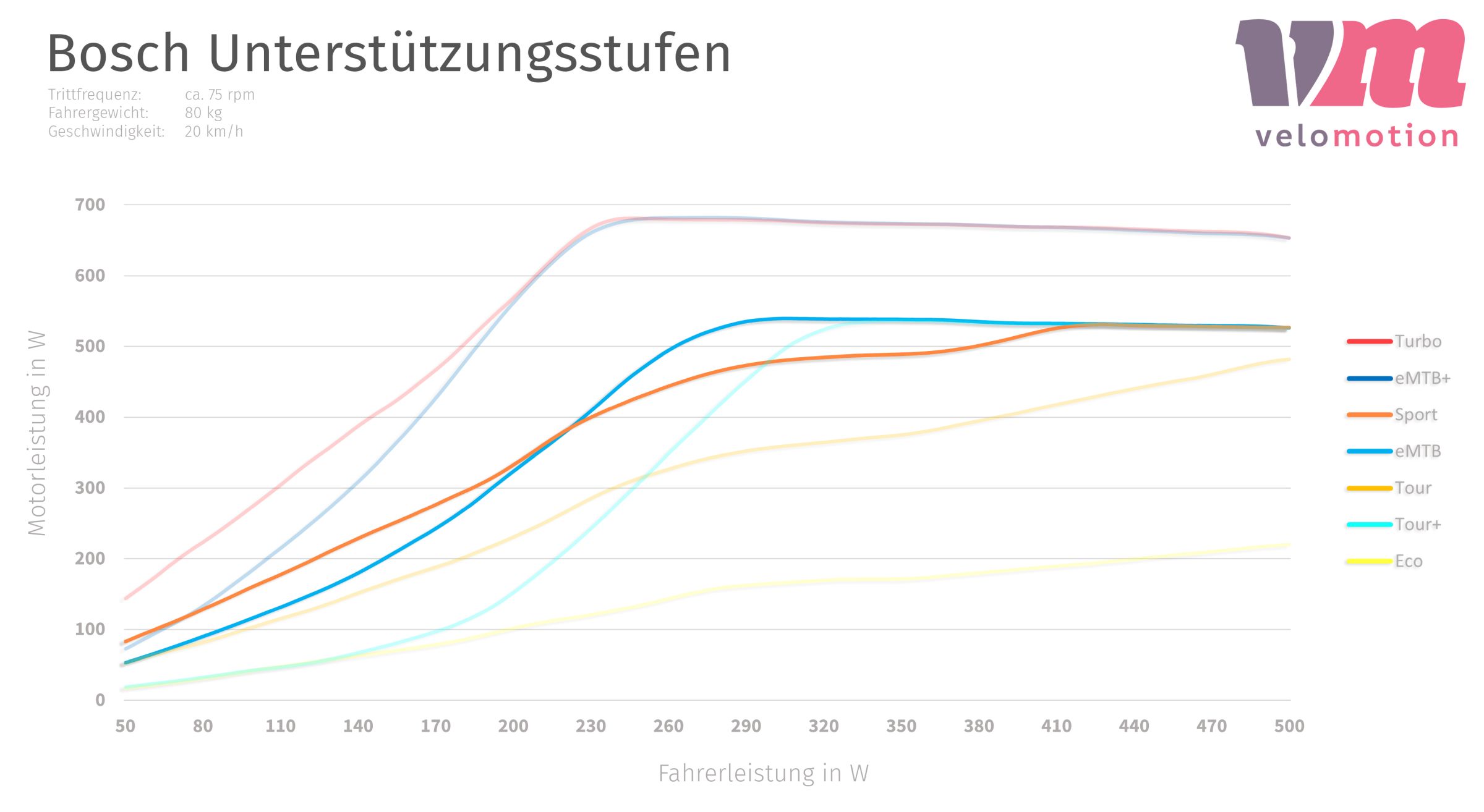
- Tour+ – The all-rounder with the widest range: Arguably the most interesting mode in the test field is Tour+. It is the most progressive of all and covers an enormous range. At low rider power up to around 130 watts, its curve is almost identical to the weak Eco mode. In this range, it is extremely energy-efficient. However, if the rider pedals harder, the mode springs to life. Its curve rises steeply, overtaking the linear Tour mode and even the Sport mode, until it finally reaches a maximum power level on par with Sport and eMTB. It thus bridges the gap between the most economical and the second-most powerful mode. In the factory settings, however, the Tour+ mode often feels a bit too weak in the lower range.
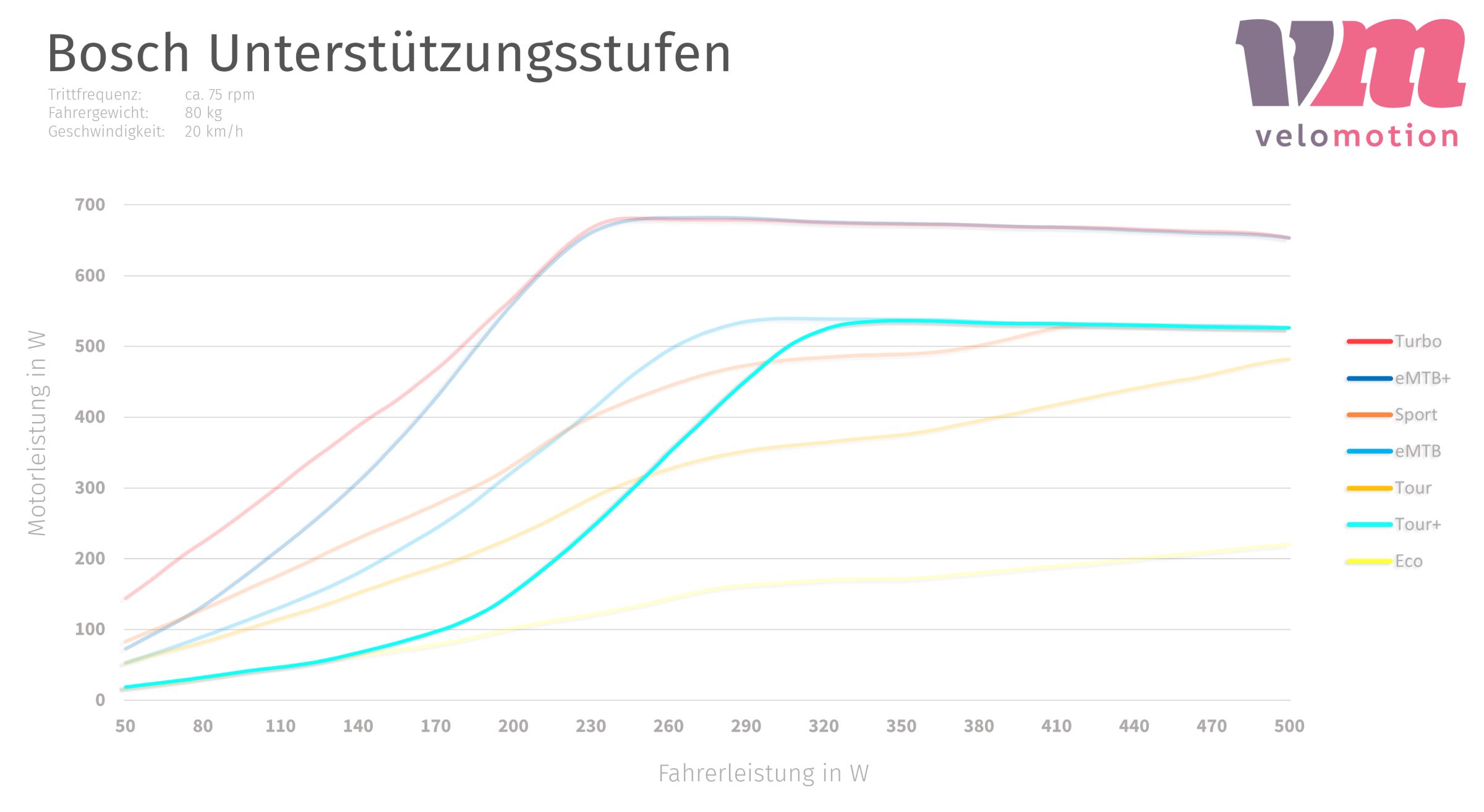
- Tour & Eco – The basic modes: At the lower end of the spectrum are the linear Tour and Eco modes. The rather large power gap between the two is striking. With a maximum motor power of around 220 watts, Eco mode is very conservative and primarily designed for maximum range. Tour mode offers noticeably more assistance and is a solid companion for moderate tours.
The support factor: The bridge between the modes
Another graphic illustrating the nature of the modes shows the development of the assistance factor depending on rider performance. This illustrates the concept of progressive modes particularly clearly. While the linear modes (Eco, Tour, Sport, Turbo) appear as almost perfectly flat lines—their assistance factor remains constant—the progressive modes exhibit steeply rising curves.
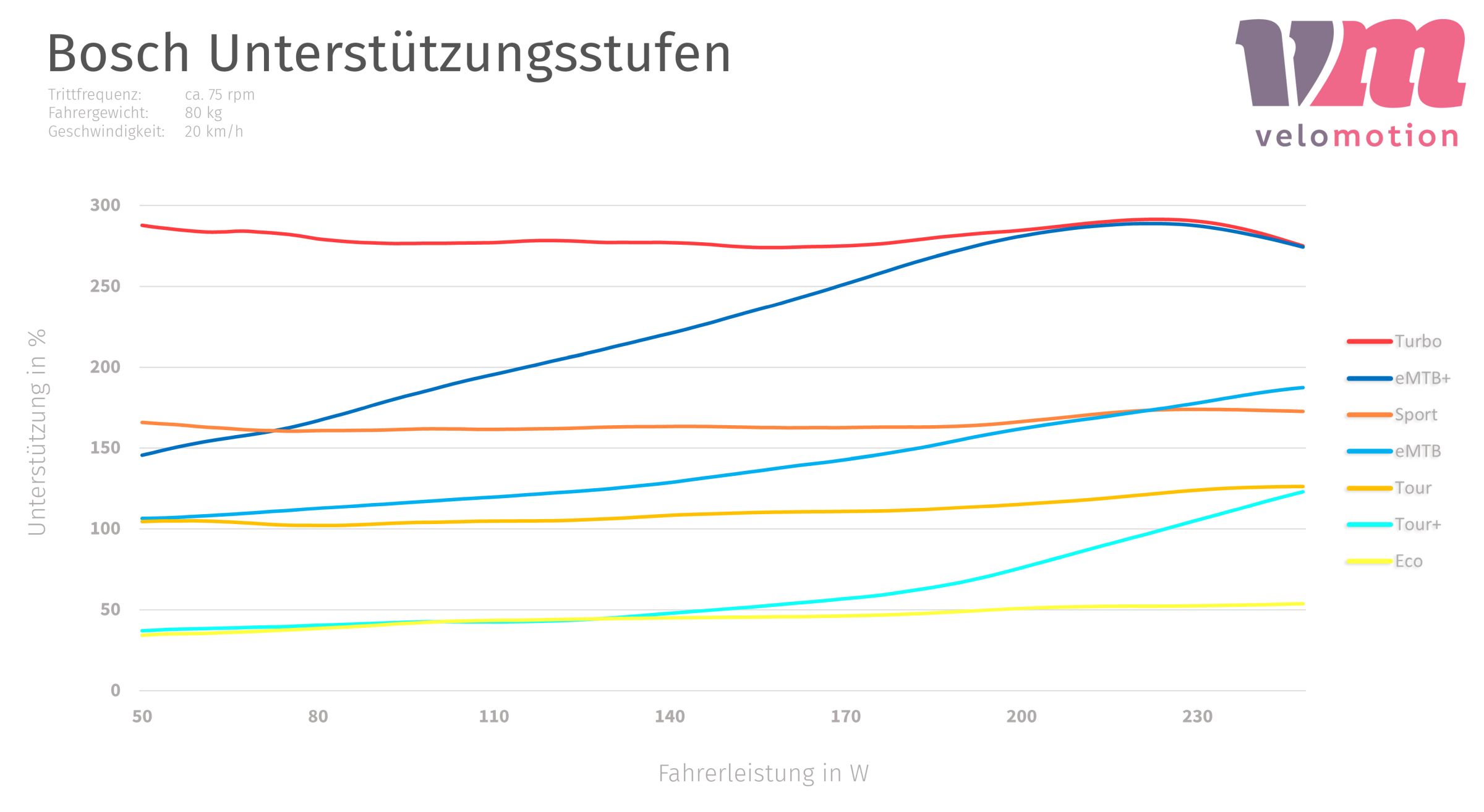
Bosch appears to have designed the progressive modes to bridge the respective linear levels. Tour+ mode ranges between Eco and Tour, depending on rider performance. eMTB mode covers the range between Tour and Sport, and eMTB+ mode covers the range between Sport and Turbo. This underscores their function as "automatic modes," allowing the rider to seamlessly access the appropriate level of assistance through their own pedaling power.
Customization via app: Fine-tuning for the perfect ride
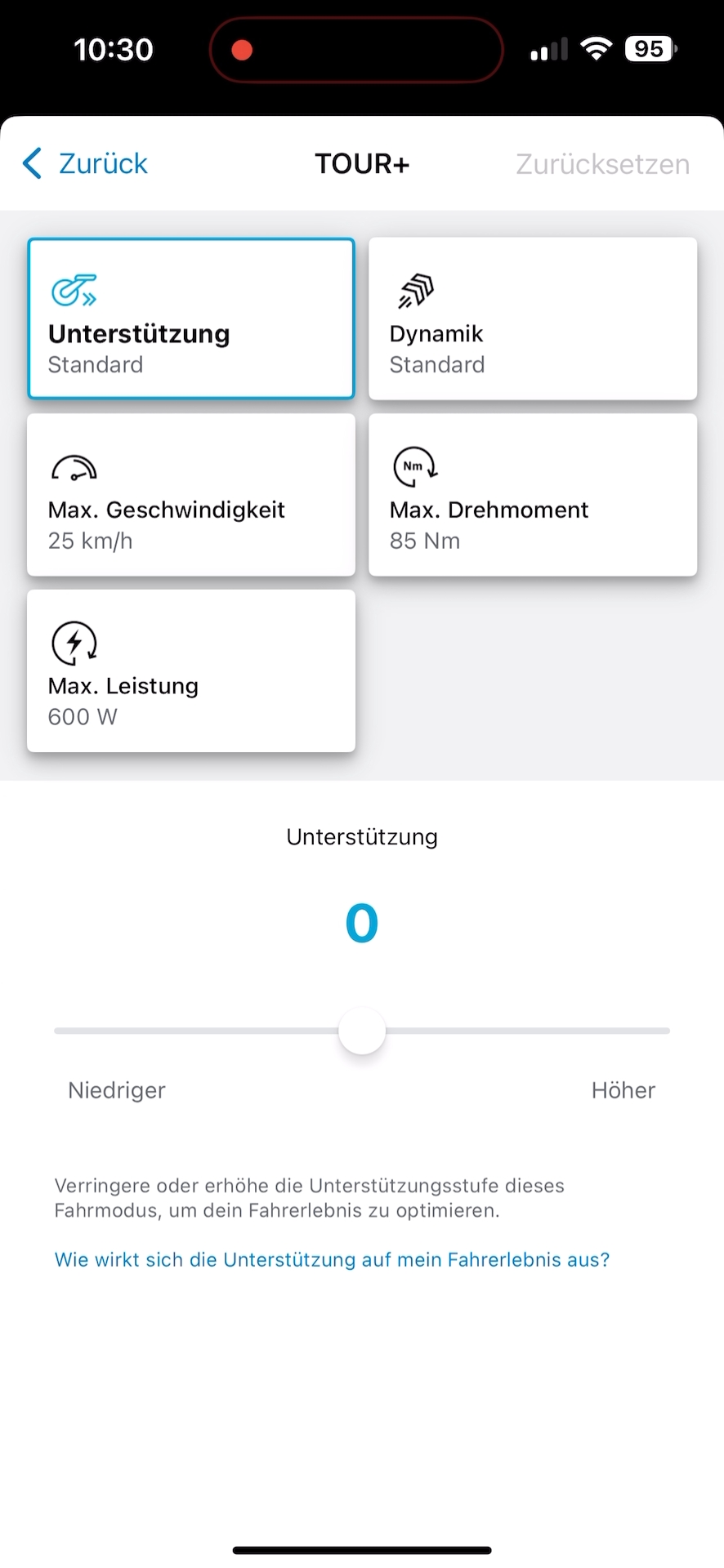
In addition to selecting the four active modes, the eBike Flow app offers additional setting options for each individual assistance level. Parameters such as assistance, dynamics, maximum speed, and maximum torque can be adjusted within a range of -5 to +5.
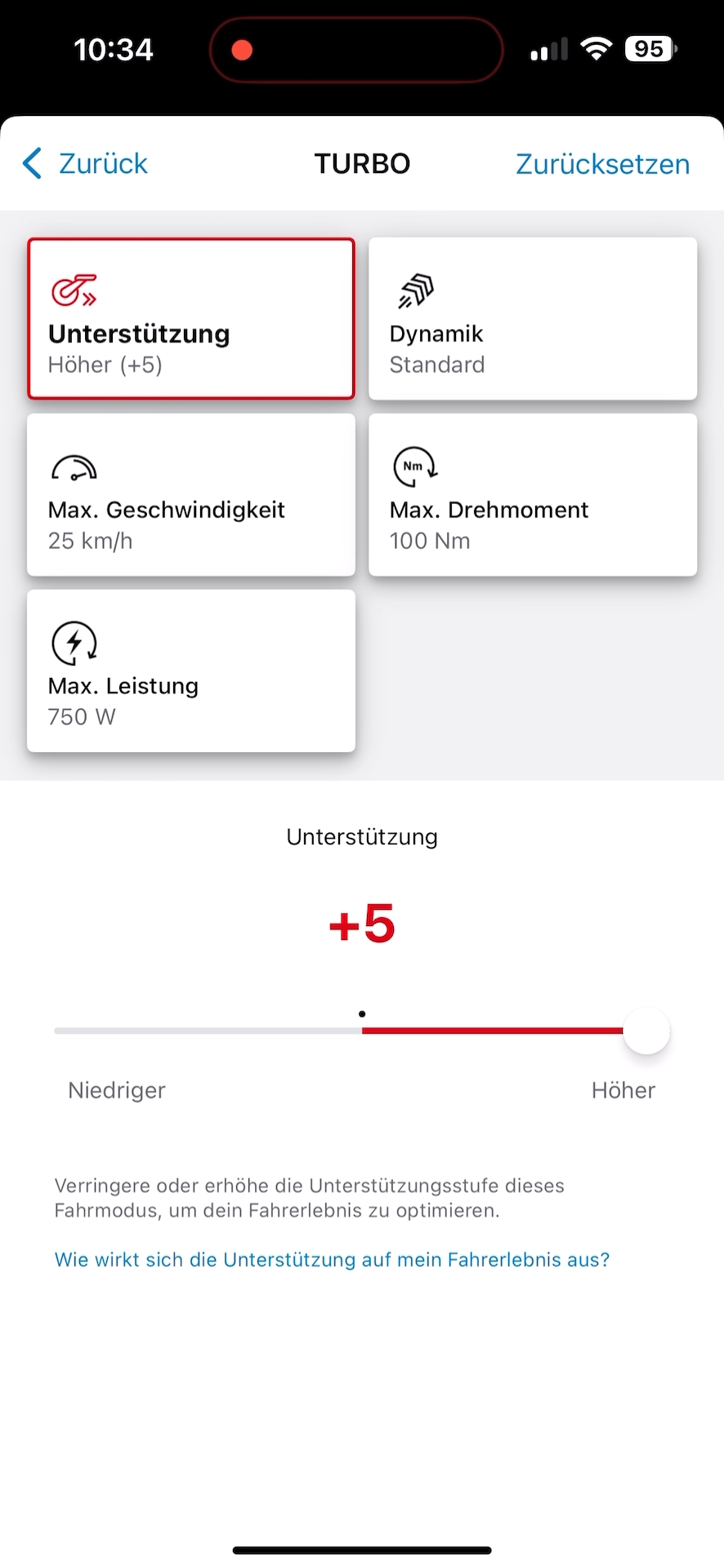
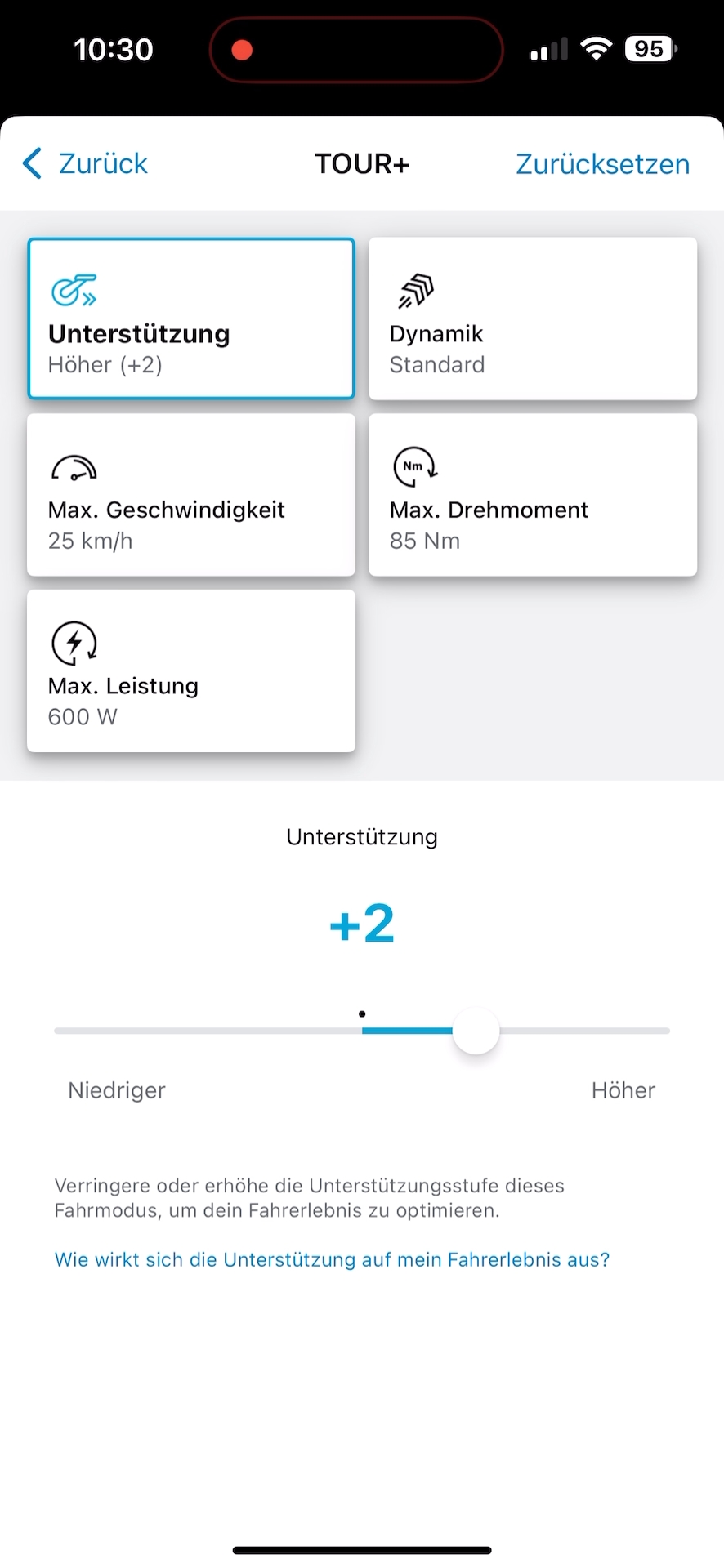
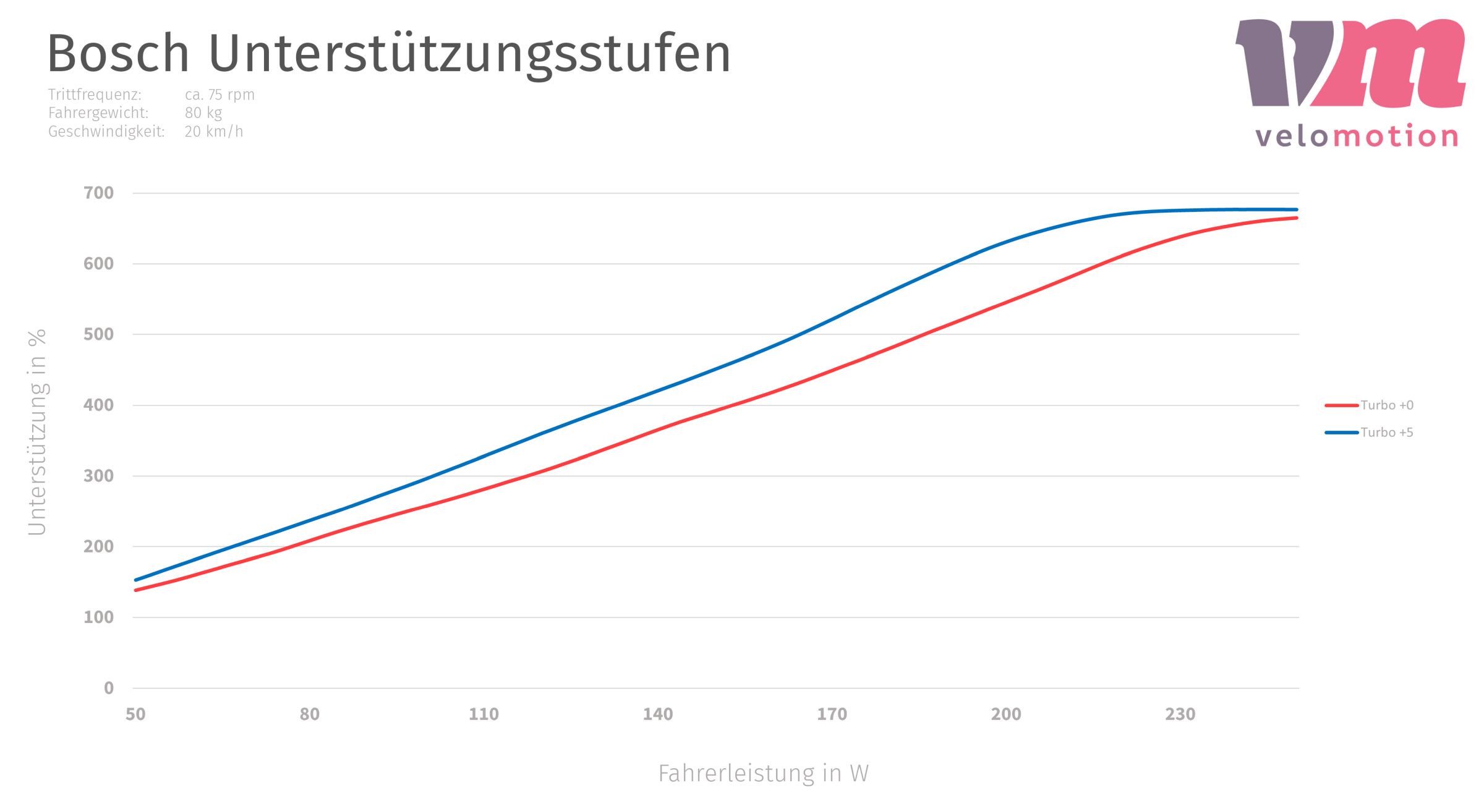
To visualize the effect of these settings, we compared Turbo mode in the default setting (0) and with maximum assistance (+5) on the test bench. The result is clear: Increasing the assistance level shifts the entire power curve upward. This means that the motor delivers more power across the entire range for the same rider effort. The bike feels noticeably more powerful.
This adjustment option is a powerful tool. A rider who finds the Tour+ mode too weak at the lower end can perfectly adapt it to their needs by increasing it to +1 or +2. This creates a customized all-around mode that's economical when you're taking it easy, but powerful when it matters most. Experimenting with these settings is highly recommended to find the perfect setup for you, your bike, and your terrain.
Special functions and energy consumption
Beyond pure power output, some modes offer special features. For example, the eMTB and eMTB+ modes feature a pronounced "Extended Boost" that allows you to push the bike over obstacles such as steps, even if you briefly stop pedaling. These modes also integrate algorithms designed to reduce rear wheel spin on loose surfaces.
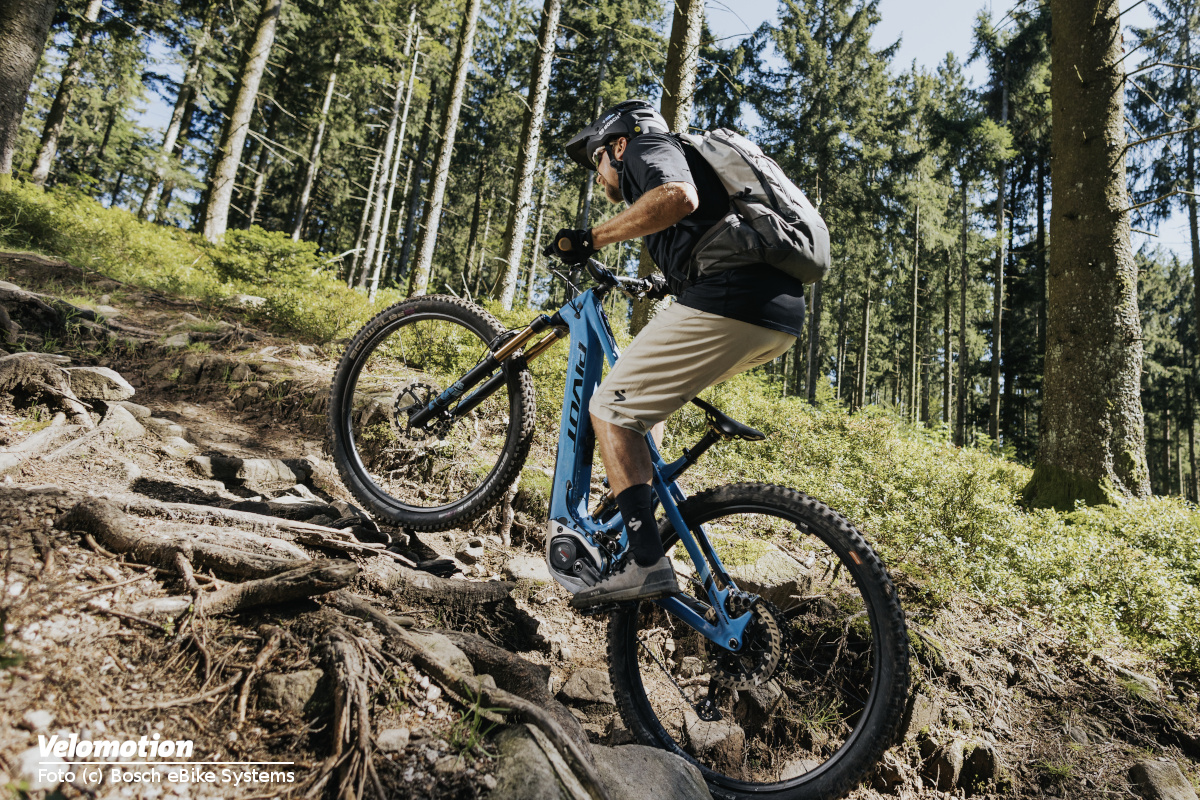
A conscious decision was made not to measure energy consumption in the laboratory. While the linear modes still allow for a certain degree of comparability, the consumption of the progressive modes is extremely dependent on riding style and terrain. A rider using the eMTB+ mode on a flat route with little personal effort will be very economical. Another rider using the same mode on a trail with many short, steep climbs will experience very high consumption, as the motor is often pushed to its peak power. Laboratory values would have little relevance for practical use.
Bosch E-Bike Modes: Huge potential for all rider types
The variety of assistance levels offered by the Bosch Smart System is far more than just marketing. It offers riders enormous potential for customizing their riding experience. The fundamental choice is between the predictable, constant linear modes and the dynamic, intuitive progressive modes. While the former are ideal for touring riders and purists who want to know exactly what they're getting, the latter demonstrate their strengths in sporty and varied terrain, where they adapt to the demands like an automatic transmission.
The Tour+ mode turns out to be the most versatile of all, and with a little fine-tuning in the app, it can become the perfect "always-on" mode for many riders. Ultimately, the clear recommendation is: Don't be afraid of the many options! Experimenting with the different modes and settings in the Flow app is worthwhile and is the key to unleashing the full potential of your e-bike.