


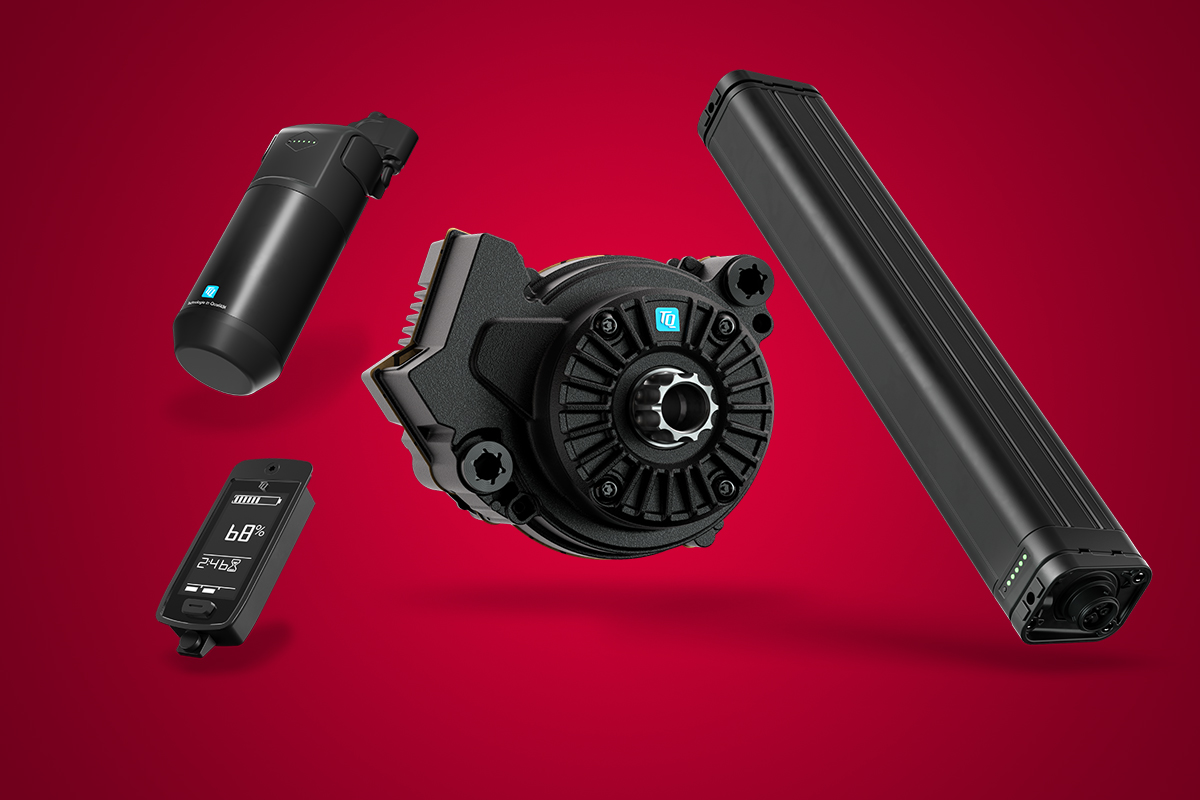
E-MTB drive test: We took a close look at the TQ HPR50. In addition to detailed driving impressions from practice, we also determined performance and consumption values on the test bench.
As the manufacturer of what is still the most powerful mid-engine, the HPR120s, TQ has undoubtedly been known to many e-bikers in recent years. At the latest with the presentation of the TQ HPR50 a few months ago, the German manufacturer should have made it into the limelight of the scene. The technical data alone shows that this drive should help determine the light E-MTB market for the next few years; With a weight of only 1.850 g for the motor unit and a complete system weight of 3,9 kg including the 360 Wh battery, it is one of the lightest things a manufacturer can currently fit in a bike. In addition, there is its compact design and the round form factor, which makes the elegant integration comparatively easy.
TQ HPR50: Specifications
- Weight engine: 1,85 kg
- Max. Torque: 50 Nm
- Battery capacity: 360 Wh
- Battery weight: 1.830 g

In terms of performance, with a maximum torque of 50 Nm, it cannot of course compete with "full-fledged" mid-engines, but it does place itself in the midfield among the Light-Assist models. Incidentally, the functionality is similar to that of the "big brother" HPR120s. The eponymous Harmonic Pin Ring Technology is used in a similar way in other electric motors from TQ (e.g. in satellites). The power transmission inside does not take place via belts, chains, gears or the like as with almost all other mid-engines at the moment. This should reduce the volume and make the compact design possible in the first place.
TQ HPR 50: On the test bench - unexpected challenges
Like numerous other e-bike drives in the past, the TQ HPR50 also had to prove itself on the test bench. However, this endeavor turned out to be much more complicated than we had expected. In the conventional test setup, the compact engine could not be motivated to cooperate. Although a crank arm was moved automatically with different powers, the TQ HPR50 did not provide any support, although it worked without any problems in "real conditions", i.e. when driving with muscle power.
A conversation with TQ later, we also knew why our proven test method was unsuccessful: Due to its compact design, there was no space in the motor unit for a conventional torque sensor. determined. In everyday e-biking, i.e. when a flesh and blood rider pedals, this is a very clever move. Unfortunately, however, this realization did not help us to get the engine in our structure to work together. Laboratory manager Veit therefore took the task into his own hands and quickly got on the test bike himself. The input power was measured using Garmin wattmeter pedals and the input power, which fluctuated more than the machine, was averaged.
Three bikes, three drives?


Before we get to the performance data, we would like to point out another special feature: For this test we had three different TQ E-MTBs in the laboratory: a Trek Fuel EXe, a Scott Lumen eRide and a Simplon Rapcon TQ. The measurements showed what the bike manufacturers and TQ had already indicated to us in advance: Every bike has a slightly different support characteristic. Bicycle manufacturers have the option of adapting the drive software – at least in part – to their own bike. In addition, TQ itself also offers other software for e-gravel bikes and e-racing bikes with the HPR50. However, these different characteristics can almost always be “adjusted” or individualized by the driver using the TQ app. However, this circumstance makes it a bit more complicated to talk about the TQ HPR50 in general. We have decided on an average.
Offering
To determine the maximum power, we switch the drive to its highest support level and apply 250 W to the crank. This measurement is intended to reflect extreme situations in which the drive has to reach its limits - for example when overcoming steps. Here, the TQ HPR50 is roughly on par with the Fazua Ride 50, beats the aging Specialized SL 1.1, but doesn't quite reach the power of the Fazua Ride 60 or the Shimano EP8 RS. Nevertheless: In view of its weight and the impressively low noise development, this is a remarkable value.

In addition to this extreme load, we also try to depict a more everyday scenario by giving a relaxed 100 W to the crank. The determined values for the TQ HPR50 are a novelty, because it is by far the sportiest drive that we have ever had in the test. In plain language: With 100 W rider power, not too much happens in terms of support. In order to motivate the engine to do more work, it has to be around 150 W input power, where it then gains a significant gear.

energy consumption and range
In addition to the performance, we always measure the energy consumption of the drive. Normally, these measurements are made both on the flat and on the mountain. However, since we (or Veit - thanks!) had to pedal ourselves in the case of the TQ HPR50, we decided not to take the time-consuming measurements for consumption on the flat. Instead, we measured how much energy the HPR50 draws from the battery per kilometer driven on a simulated incline of 10% in the highest support level. Here it is clear that all drive manufacturers just boil with water and nobody can outwit physics: Drives that have more power (e.g. Fazua Ride 60 or EP8 RS) consume correspondingly more energy, while the HPR50 is frugal here.

For the theoretical ranges, this means that even with the rather small 360 Wh battery of the system, larger tours can be envisaged, at the latest by installing the optional range extender with an additional 160 Wh capacity, at least sporty drivers should then easily be able to get over one come all day.


Batteries: Lightweight 360 Wh battery and optional range extender
The TQ HPR50 is a closed system. This means that bicycle manufacturers who install the drive also rely on the associated battery with a capacity of 360 Wh. This is not only very compact, but also very light for its capacity at 1.830 g. It is installed inside the frame or in the down tube. Whether it is possible for the user to remove it for charging depends on the bike manufacturer - while on the Trek Fuel EXe, for example, it can be pulled out via a flap on the bottom bracket, owners of the Simplon Rapcon TQ have to do without such a removal option.


A compact range extender with an additional 160 Wh capacity is optionally available for the system, which is hardly larger than a drinking bottle and at 900 g hardly exceeds its weight. This is mounted on the down tube. When charging the system, the charger then recognizes the mounted range extender and charges the internal battery first – nice.
Controls: That's the way it should be!
The operating concept of the small TQ drive matches its sporty orientation: the monochrome display in the top tube is supported by a compact remote on the handlebars, which only needs two buttons. The operation is intuitive, thanks to the design and mounting points of the elements, they are also well protected in the event of a fall.

The rubber coating on the control panel is a positive feature, which significantly improves handling, especially when it is wet. The display is very easy to read, even in direct sunlight, and clearly shows the most important information, even if the content can vary slightly from bike to bike. In everyday life, however, it would have been nice if the battery charge level and the support level were differentiated in color - that way you could better capture the most important information from the corner of your eye. However, that is whining at a high level.

TQ E-Bike App: For the tinkerers
TQ also provides its drive with an app developed in-house. This is deliberately reduced and is intended to be used for fine adjustment and individualization to one's own needs. Accordingly, after connecting via Bluetooth, the individual support levels can be adjusted to the circumstances or personal preferences. The parameters maximum power, support factor and "pedal response" are available here. The latter can be used to set how dynamically the drive reacts to your own pedal pressure.
Bicycle manufacturers are free to offer an adapted and/or extended app in cooperation with TQ. In the case of the Trek Fuel EXe, this is called the Trek Central App and offers a much larger range of functions. Routes can be planned, navigated and recorded. The individual calculation of the range for all support levels is also possible.
TQ HPR50 driving impression: Discreetly sporty
We have now lost a lot of words about performance values and technical data. Important factors, no question - but whether you like an e-bike drive or not is not decided on the test bench or when reading a data sheet, but in practice. Here it must be said very clearly that TQ with the new light drive is pursuing the basic sporty orientation more consistently than any other manufacturer to date. Two factors are clearly noticeable here and also make the HPR50 stand out from the "mass" of electric drives: naturalness and background noise.

Right from the first step and in all support levels up to the maximum, the drive never pushes itself uncomfortably into the foreground. Instead, it supplements its own performance almost unnoticed, but without missing out on power, although the difference to full-power drives is clearly noticeable at all times. Its sporty tuning with little driver performance is also unique and will certainly take some getting used to for e-bikers who come from other mid-motors. If you are looking for a drive that pulls the e-bike and rider up the climb to the summit in a relaxed manner, you should look elsewhere. However, if you don't have a problem working up a sweat, but climbing the mountain twice as fast as a non-motorized bike - that's what drives you! When it comes to cadence, the HPR50 has its sweet spot between 80 and 90, and it tends to get along better with a higher cadence than with a lower one.

This currently unrivaled naturalness is underlined by the background noise of the drive. We deliberately don't say volume, because at higher power the HPR50 is quite audible, especially at high cadence. However, TQ has recognized that it is not primarily the level that matters for the subjective perception, but rather the tonality: The drive is never uncomfortable, but hums to itself in a less intrusive pitch. It also reacts less strongly than many other drives to sudden load changes - while the competition here often drifts into a squeak that can hardly be ignored, the TQ HPR50 actually always stays in the background and is often drowned out by ambient or road noise, especially off-road.
The silence on the descent was also noticeable: None of our three TQ test bikes gave an unpleasant drive chatter here. Is that due to the respective E-MTBs or to the drive itself? It's certainly not possible to say that, but it shows that the drive itself has no tendency to rattle.

So is the TQ HPR50 flawless? Not quite - we noticed two small things negatively during the test. On the one hand, there is the control panel, which is too stiff for our taste: Even if the buttons have a pleasant pressure point and the rubber coating is very pleasant, it still takes a surprising amount of finger strength. Sure, that's a fine line and certainly a bit subjective. Nevertheless, we would have liked a little less operating force.
During our laboratory tests with the Garmin wattmeter pedals, it also became apparent that the display of the rider's power on both the Trek Fuel EXe and the Scott Lumen eRide deviated significantly from the power actually pedaled - especially at above-average high or low cadence. This is not a broken leg, anyone who attaches great importance to it will fall back on solutions such as the watt meter pedals anyway. Nevertheless, you should be aware of this and not overestimate the displayed performance.
The TQ HPR50 is currently probably the best light E-MTB drive for sporty riders who value natural handling and a pleasant background noise. For this you have to make compromises in terms of maximum power, also in comparison with other current light motors such as the Fazua Ride 60.